
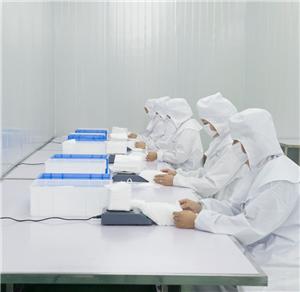
Die Meltblown-Qualitätskontrolle ist der entscheidendste Faktor für die Leistung von KN95-Masken. Dieser Leitfaden behandelt Rohstoffprüfung, Prozessüberwachung, Labortests, Überprüfung der elektrostatischen Ladung und praktische Audit-Schritte für B2B-Käufer.
How Is KN95 Meltblown Quality Controlled?
The Critical Role of Meltblown in KN95 Performance
For any B2B buyer evaluating a kn95 mask manufacturer, understanding the meltblown production process is not optional-it is the single most decisive factor separating compliant respirators from substandard products. Meltblown nonwoven fabric serves as the filtration layer that captures airborne particles, and its quality directly determines whether a mask meets the KN95 standard's requirement of filtering at least 95% of non-oily particles at 0.3 microns.
What Makes Meltblown Quality Control Unique?
Unlike standard textile production, meltblown manufacturing involves extruding molten polymer through fine nozzles and attenuating it with high-velocity hot air to form microfibers. Quality control must address four interrelated parameters:
- Fiber uniformity: Inconsistent fiber diameter creates weak spots in filtration.
- Basis weight variation: Even small deviations can alter filtration efficiency.
- Electrostatic charge retention: Many KN95 masks rely on electret treatment.
- Melt flow index (MFI) stability: The polymer's MFI must remain within a tight range.
Key Quality Control Checkpoints in Meltblown Production
Raw Material Inspection
Before production begins, the kn95 mask manufacturer must verify incoming polypropylene resin, testing for melt flow index, contamination levels, and moisture content.
In-Process Monitoring During Extrusion
Parameters that must be controlled include extruder temperature profile, hot air temperature and pressure, die-to-collector distance, and collector speed. A modern manufacturer will use automated sensors to log these variables every few seconds.
Offline Laboratory Testing
Every production lot should undergo laboratory testing including filtration efficiency (using NaCl aerosol at 85 L/min), pressure drop, basis weight, fiber diameter distribution, and electrostatic charge decay. The kn95 mask manufacturer should maintain records of these tests for at least three years.
Electrostatic Charging Verification
Quality control must include measurement of surface potential immediately after charging, accelerated aging tests, and verification that filtration efficiency remains above 95% after aging. Justsun's KN95 products use five-layer meltblown construction with electrostatic layer, maintaining at least 95% filtration on inhalation.
How to Audit a KN95 Mask Manufacturer's Meltblown QC
Documentation Review
- Do they have a written quality manual covering meltblown production?
- Are there SOPs for raw material inspection, in-process monitoring, and final testing?
- Can they show calibration certificates for test equipment?
On-Site Observation
- Is the meltblown line in a clean environment?
- Are operators wearing appropriate PPE?
- How are rejected rolls segregated?
Sample Testing
Request a sample of meltblown fabric from the same lot used for a finished mask. Have it tested by an independent laboratory for filtration efficiency and pressure drop. Compare results to the manufacturer's in-house data.
Common Quality Pitfalls
- Basis weight variation across web width: Causes inconsistent filtration in masks from the same roll.
- Fiber diameter drift over long runs: Reduces filtration efficiency as die accumulates deposits.
- Electrostatic charge loss during storage: Charge can dissipate within weeks if not stored properly.
Selecting a KN95 Mask Manufacturer: Beyond Meltblown QC
While meltblown quality control is paramount, a reliable kn95 mask manufacturer will also demonstrate traceability, finished product testing, third-party certification, and responsive communication.
Frequently Asked Questions
Q: Can a KN95 mask manufacturer use imported meltblown?
A: Yes. The key is that the manufacturer must verify the incoming material meets their specifications.
Q: How often should meltblown filtration efficiency be tested?
A: Ideally, every production roll should be tested at multiple points. At minimum, test one sample per roll.
Q: Does higher basis weight always mean better filtration?
A: No. Higher basis weight increases pressure drop. The goal is to achieve 95%+ filtration with the lowest possible pressure drop.
Conclusion
For any B2B buyer, the meltblown production process is the heart of KN95 mask quality. By focusing on raw material inspection, in-process monitoring, laboratory testing, and electrostatic charge verification, you can identify a manufacturer that delivers consistent, compliant products. Request a meltblown sample and ask for their quality control documentation today.