
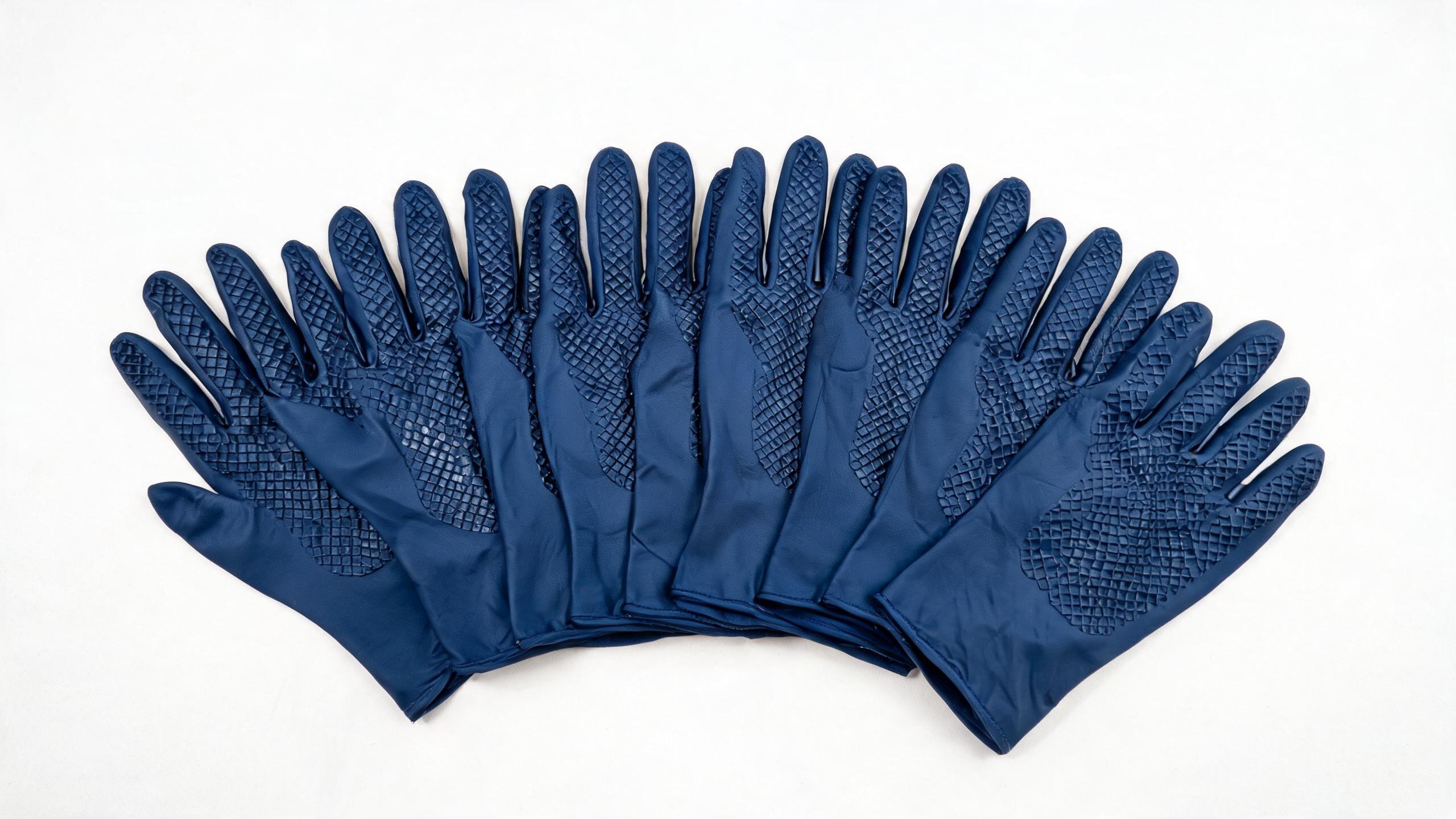
A buyer's guide to evaluating a nitrile gloves manufacturer at the plant level. It explains what a dipping-line capacity claim actually depends on, which evidence to request for each claim, what to inspect at every production stage, how to tell a real factory from a trading supplier, and how to verify documents and lots when you cannot visit in person.
A capacity number on a quotation tells you almost nothing on its own. A nitrile gloves manufacturer can claim any monthly volume, but the figure only becomes meaningful when it is tied to a line count, a shift pattern and an output per line that you can cross-check. This guide is written for buyers who have already settled on the material and now need to judge the plant behind the offer. If you are still comparing nitrile with latex, read our material performance and allergen risk comparison first; if you are narrowing a supplier shortlist, the disposable gloves supplier selection guide covers commercial terms.
Key takeaways
- Capacity is a derived figure: line count times output per line times operating hours. Ask for the inputs, not the total.
- A dipping line matters because it sets former count, cure consistency and changeover flexibility, not just throughput.
- Company certificates and product test reports are different documents. EN 455 compliance is shown by test reports for the specific product and lot.
- Raw material batch traceability and pinhole testing records are the two items that most often expose a trading intermediary.
- Live video walk-throughs plus carton-to-batch traceability can substitute for a site visit, if you script them in advance.
Manufacturer or middleman: settle this before anything else
The distinction is not about size. A small plant that compounds, dips, strips and packs is a nitrile gloves factory; a large trading house that buys finished cartons and re-labels them is a nitrile gloves supplier. Both can serve you, but they fail differently. A plant controls cure parameters and can adjust a formulation; a trader controls neither and can only relay your complaint upstream.
Trading relationships are legitimate and common, and some traders add real value in consolidation and documentation. The problem is a trader presenting as a plant, because then every technical answer you receive is second-hand. Two simple questions separate them: who compounds the nitrile, and who owns the formers? A plant answers both without hesitation because those are the two assets its process depends on.
Justsun (Xiamen Jiasheng Foreign Trade Co., Ltd.) operates as a manufacturer of CE/FDA-certified disposable medical supplies and protective nonwoven products, from a 26,100 m2 facility with 400+ employees and an in-house quality control centre. Its nitrile range covers powder-free blue exam gloves at 0.11 mm with AQL 1.5 and EN 455-1/-2/-3, industrial dark blue 8 mil gloves to EN 374 with a 12-inch cuff and diamond-texture grip, heavy-duty orange 0.15 mm gloves to EN 374, sterile gamma-irradiated nitrile exam gloves at 0.15 mm with AQL 1.5, and textured black exam gloves with AQL 1.5 to EN 455.
What a capacity claim should be backed by
Every capacity figure decomposes into the same three inputs. Ask for them separately; a manufacturer that knows its plant will give you consistent numbers across all three. A supplier working from a forwarder's schedule usually cannot.
| Claim made | Evidence to request | What a weak answer looks like |
|---|---|---|
| "We can supply X million gloves per month." | The arithmetic: number of dipping lines, formers per line, output per line per hour, shifts per day, working days per month, minus planned maintenance and changeover. | A single round number with no breakdown, or a figure that does not reconcile when you multiply the parts back together. |
| "We run 24-hour production." | Actual shift structure by line, headcount per shift, and which lines run which products. | "Three shifts" as a slogan, with no indication of whether inspection and packing are staffed at the same hours as dipping. |
| "Capacity is available for your order." | Current committed load by line, lead time quoted per line, and the line your order would be scheduled on. | Lead time that changes after the deposit, or a refusal to name the line. |
| "We make all our own gloves." | Which SKUs are produced in-house and which are bought in; whether the sterile line is on the same site. | Vague answers, or a catalogue where every item is described as factory-produced. |
| "Our QC is in-house." | Where pinhole testing and AQL sampling physically happen, and whether that equipment is on the same site as the lines. | Testing described as a service performed elsewhere, with no access to records. |
What a dipping line actually implies
A nitrile line is a chain of ceramic or porcelain formers travelling through a coagulant dip, a nitrile bath, ovens, a leach bath, a beading station, a strip station and a cure tunnel. When a buyer hears "we have dipping lines," the useful questions are about the formers and the ovens, because those two determine consistency. Former condition affects wall thickness distribution at the fingertips and cuff; oven control affects cure and therefore tensile strength and elongation after ageing.
Formers are consumables with a finite life. Ask how often formers are inspected, replaced and cleaned, and whether there is a record. A plant that reconditions formers on a schedule and can show it is managing the variable your order will actually be affected by. Output per line is also not a fixed number: a thick industrial glove at 8 mil runs slower than a thin exam glove, so a single blended output figure across a mixed catalogue is a warning sign rather than a selling point.
The audit checklist, stage by stage
An audit report is only useful if you can map its findings onto the physical route your gloves take. Read it in production order.
Raw material and compounding
- Batch traceability: can the factory link a finished carton back to a nitrile latex batch number, a receiving date and a supplier certificate of analysis? Ask to see one worked example, end to end.
- Incoming inspection: are there records for viscosity, solids content or pH on received latex, and are out-of-spec batches quarantined?
- Compound preparation: batch records showing mix time, temperature and any additives, with who performed and who verified.
Forming, dipping and curing
- Former handling: cleaning records, inspection intervals, and what happens to a former with surface damage.
- Process parameters: logged oven temperatures and line speed per shift. Logs that are filled in retrospectively at shift end, in identical handwriting, are a sign of a paperwork culture rather than a control culture.
- Changeover: how a colour or formulation change is handled and how much material is purged between products.
Testing: pinhole, water leak and AQL
This is where EN 455-1 is decided. Compliance for a lot generally means a pinhole and water-leak test performed on a defined sample, with an Acceptable Quality Level applied to the result. AQL 1.5 is the level declared on the products above; it is a sampling plan, not a defect rate promise, and the report should let you see the sample size, the number of failures and the accept or reject decision.
- Water-leak testing per EN 455-1: equipment, procedure, who performs it, and retained records per lot.
- AQL sampling: which inspection level, which lot size, and whether sampling happens before or after packing.
- Calibration: records for the gauges used in thickness measurement and any test equipment, with dates and traceability.
- Physical testing to EN 455-2: tensile strength and elongation before and after ageing, with the test house identified.
Powder-free processing and packing cleanliness
- Powder-free route: for powder-free items, evidence of the chlorination or polymer coating stage and the washing that follows, with water quality checks.
- Packing area: separation from the dipping hall, hygiene controls, glove and garment rules for packers, and pest control records.
- Count and labelling: how the declared count per box is verified, and how labels link to the lot.
For sterile nitrile exam gloves, add gamma irradiation dose records and sterility assurance documentation to the list, and confirm that the sterile product is processed on a controlled route rather than simply packed from the same stock as non-sterile gloves.
Reading certificates versus test reports
Buyers regularly accept the wrong document. A company-level certificate, such as a quality management system certificate or a CE marking document for a product family, confirms that a system or a declaration exists. It does not tell you how a specific lot performed. A product test report is the document that speaks to EN 455 compliance for a specific article, and it should name the product, the standard, the test method, the laboratory and the date.
When you check EN 455 claims, ask for the reports covering EN 455-1 (freedom from holes), EN 455-2 (physical properties) and EN 455-3 (biological evaluation) for the exact product you are buying, and confirm the report is current rather than an older version of the same product. The same logic applies to EN 374 for the industrial and heavy-duty gloves: the report should match the glove, its thickness and its intended chemical protection claim.
Two further checks are worth the effort. First, does the scope on the company certificate actually include disposable nitrile examination gloves, or does it cover unrelated products? Second, is the certificate issued to the plant or to a trading entity with a different name? Neither is automatically disqualifying, but you should understand the relationship before you rely on the document.
Remote verification when you cannot travel
Most buyers will not visit every candidate plant. Remote verification works if you script it rather than accept a photo gallery.
- Live video walk-through: ask for a scheduled call, not a recorded video. Request a continuous walk from the raw material store, past the lines, to the testing bench and the packing hall, with the camera kept running. Recorded clips can be edited; a live call with your questions in it is much harder to stage.
- Lot traceability drill: give the factory one carton reference from a previous shipment and ask them to produce the batch number, the production date, the line, the test record and the raw material certificate behind it. A plant can usually do this within a day; an intermediary often cannot.
- Third-party pre-shipment inspection: commission an inspection with a defined scope: quantity, count per box, labelling, packaging condition and an independent check of the declared specifications. Agree in advance whether the inspector will pull samples for pinhole testing, and how the results will be reported to you.
- Document cross-check: ask for the test report and the shipping documents for the same lot, then confirm they refer to the same product code.
Red flags worth acting on
- Capacity, line count and shift structure that do not multiply out to the same total.
- Refusal to name the line your order will run on, or lead times that move after the deposit.
- Test reports that name a different product, a different thickness or a different standard from what you ordered.
- Pinhole and water-leak records that exist only as a summary table with no sample sizes or failure counts.
- No calibration records for thickness or test equipment.
- A packing area that appears in no photographs and is not shown on the walk-through.
- Every SKU described as factory-made, including items clearly outside the plant's line configuration.
None of these is proof of a bad supplier. Each one is a question whose answer should be a document, and the pattern of answers tells you what kind of organisation you are dealing with. Once the plant side is settled, confirm storage and shelf-life terms using the shelf life and storage guidance for bulk buyers.
Products in the nitrile range
- Powder-free blue nitrile exam gloves, 0.11 mm, AQL 1.5, EN 455-1/-2/-3, sizes XS to XL, 100 gloves per box.
- Industrial dark blue nitrile gloves, 8 mil, EN 374, 12-inch cuff, diamond-texture grip.
- Heavy-duty orange nitrile gloves, 0.15 mm, EN 374, 100 per box.
- Sterile nitrile exam gloves, 0.15 mm, AQL 1.5, EN 455, gamma-irradiated, 100 pairs per box.
- Textured black nitrile exam gloves, AQL 1.5, EN 455.
Questions buyers ask
How do I verify a nitrile glove factory without visiting?
Combine three things: a live, unedited video walk-through on a scheduled call; a traceability drill where the factory traces one of your carton references back to its nitrile batch and test record; and a third-party pre-shipment inspection with a scope you have defined in writing, including whether samples will be pulled for pinhole testing. Ask for calibration records and one complete lot file rather than a document pack covering the whole catalogue.
What is the difference between a nitrile gloves manufacturer and a supplier?
A manufacturer compounds or buys nitrile latex and runs dipping, testing and packing on its own lines, so it controls cure parameters, former condition and changeover. A supplier buys finished gloves and handles distribution, documentation and consolidation. Both can be legitimate; the risk is a supplier presenting as a plant, which you can usually detect by asking who compounds the material and who owns the formers.
Which documents prove EN 455 compliance?
Product-level test reports covering EN 455-1, EN 455-2 and EN 455-3 for the specific glove, with the laboratory, method and date identified, supported by the lot records for water-leak and pinhole testing and the AQL sampling results. A company certificate or a CE declaration alone does not demonstrate how a particular lot performed. Confirm that the product name, thickness and standard on the report match your purchase order before you accept it.