
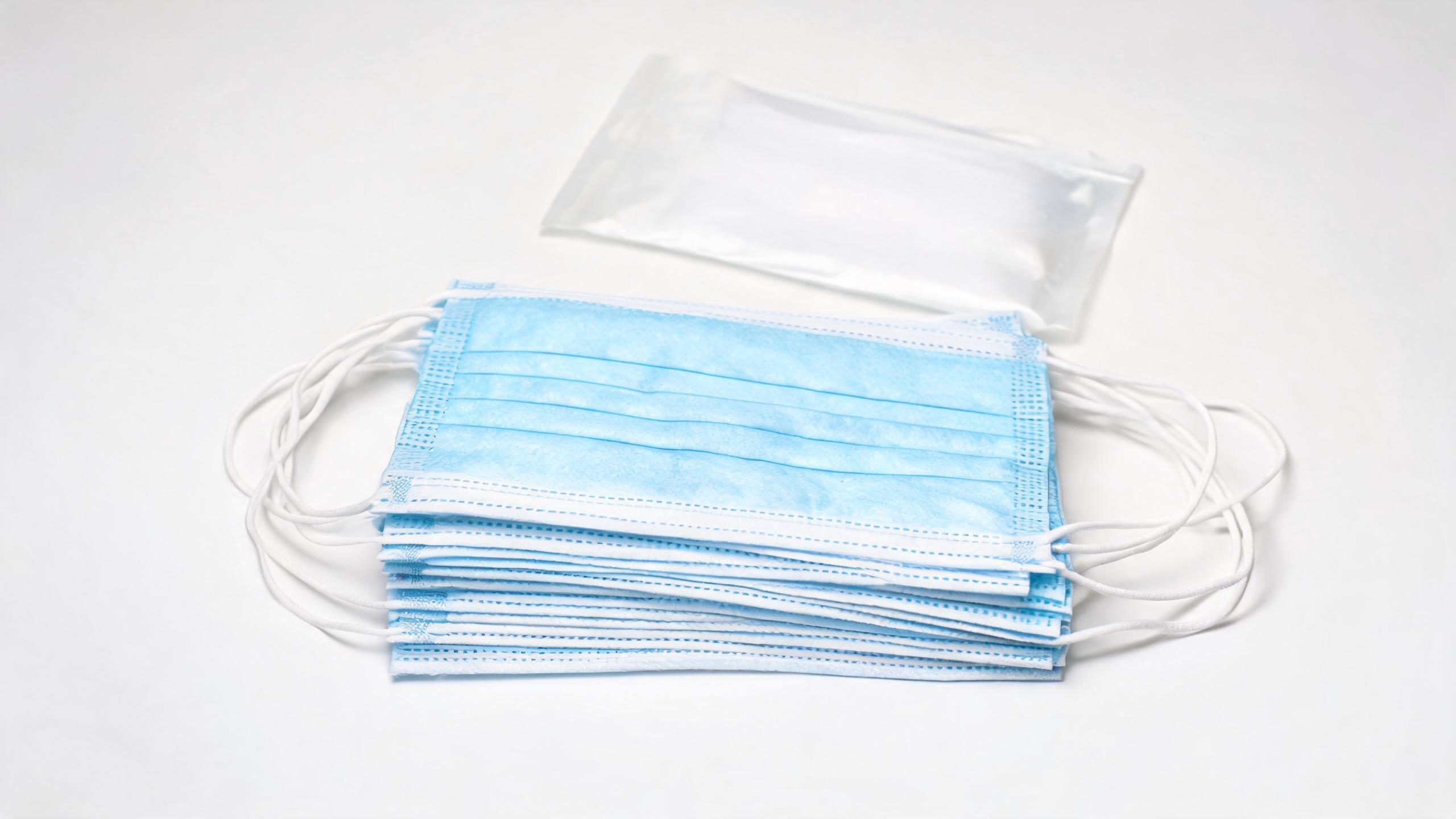
A complete guide for B2B buyers sourcing 3-ply surgical masks. Covers BFE/PFE filtration standards, EN 14683 compliance, layer construction, testing methods, and a practical procurement checklist to evaluate a disposable surgical mask supplier.
B2B PROCUREMENT GUIDE
Why This Guide Exists
If you are sourcing surgical mask 3-ply for a hospital, distributor, or government tender, the difference between a compliant product and a rejected shipment often comes down to three things: filtration performance, layer construction, and supplier documentation. This guide walks through the technical standards (BFE, PFE, EN 14683), the physical build of a 3-ply mask, and a practical checklist to evaluate a disposable surgical mask supplier before placing a bulk order.
• BFE ≥ 98% is the minimum for a surgical mask; medical-grade requires BFE ≥ 99% and PFE ≥ 99%.
• EN 14683 Type IIR is the most common European standard for medical face masks.
• Layer construction (meltblown weight, grammage, ultrasonic bonding) directly affects filtration.
• A reliable supplier should provide test reports from an accredited lab, not just a certificate of analysis.
• Bulk procurement requires checking MOQ, lead time, packaging, and regulatory documentation in advance.
1. Understanding Filtration Standards: BFE and PFE
Two acronyms dominate every surgical mask specification sheet: BFE (Bacterial Filtration Efficiency) and PFE (Particulate Filtration Efficiency). They measure different things, and a buyer who confuses them risks ordering the wrong product.
BFE (Bacterial Filtration Efficiency)
BFE measures the mask's ability to filter aerosolized bacteria (typically Staphylococcus aureus with a mean particle size of 3.0 ± 0.3 µm). The test is performed at a flow rate of 28.3 L/min, simulating moderate breathing. A standard surgical mask must have BFE ≥ 95% (ASTM F2100 Level 1) or BFE ≥ 98% (EN 14683 Type I). Medical-grade masks for surgery typically require BFE ≥ 99%.
PFE (Particulate Filtration Efficiency)
PFE measures filtration against non-biological particles, usually 0.1 µm polystyrene latex (PSL) spheres. This is a more demanding test because the particles are smaller than bacteria. A medical-grade surgical mask BFE filtration spec sheet will often show PFE ≥ 99% at 0.1 µm. This is important for protecting against airborne particulates, not just droplets.
| Parameter | Particle Size | Typical Requirement (Medical) | Test Standard |
|---|---|---|---|
| BFE | 3.0 µm (bacteria) | ≥ 99% | ASTM F2101 / EN 14683 |
| PFE | 0.1 µm (latex spheres) | ≥ 99% | ASTM F2299 |
| Differential Pressure (ΔP) | — | < 40 Pa/cm² (Type IIR) | EN 14683 |
| Splash Resistance (Synthetic Blood) | — | ≥ 120 mmHg (Type IIR) | ASTM F1862 |
Why Both Matter
A mask with high BFE but low PFE may still allow fine particles through. Conversely, a mask with high PFE but low BFE may not effectively block bacterial droplets. For a medical face mask EN 14683 Type IIR, the standard requires BFE ≥ 98% and a splash resistance test. For surgical use in operating rooms, most buyers specify BFE ≥ 99% and PFE ≥ 99%.
2. EN 14683: The European Standard for Medical Face Masks
If you are exporting to Europe, EN 14683:2019+AC:2019 is the applicable standard. It classifies masks into three types:
- Type I — BFE ≥ 95%. Not for surgical use. Suitable for patients and general public to reduce spread of infection.
- Type II — BFE ≥ 98%. For healthcare workers in non-surgical settings.
- Type IIR — BFE ≥ 98% + splash resistance (≥ 120 mmHg). For surgical use. This is the most common specification for hospital procurement.
The standard also defines microbial cleanliness (bioburden) limits: the mask must not harbor more than 30 CFU/g of bacteria. This is often overlooked by first-time buyers but is a regulatory requirement for CE marking under the Medical Device Regulation (MDR) 2017/745.
What to Ask Your Supplier
When evaluating a surgical mask manufacturer China or any other origin, request the following documents:
- Test report from an ISO 17025 accredited laboratory confirming BFE, PFE, ΔP, and splash resistance.
- CE certificate (if exporting to EU) issued by a notified body (e.g., SGS, TÜV, BSI).
- Declaration of conformity (DoC) to EN 14683.
- Bioburden test report (if required by your market).
3. Layer Construction: What Makes a 3-Ply Mask Work
A surgical mask 3-ply is not just three layers of non-woven fabric. Each layer has a specific function, and the quality of the materials determines performance.
The Three Layers
- Outer layer (spunbond polypropylene) — Water-repellent, often treated with a hydrophobic finish. Prevents fluid penetration from the outside.
- Middle layer (meltblown polypropylene) — The filtration core. Electrostatically charged to capture particles. The weight of the meltblown (typically 25–50 gsm) directly correlates with filtration efficiency. A 25 gsm meltblown can achieve BFE ≥ 99% when properly charged.
- Inner layer (spunbond polypropylene) — Soft, absorbent, and comfortable against the skin. Wicks moisture away from the wearer's mouth.
Key Quality Indicators
- Meltblown grammage: Higher grammage generally means better filtration but also higher breathing resistance. The sweet spot for a Type IIR mask is 30–40 gsm meltblown.
- Ultrasonic bonding: The layers should be bonded ultrasonically (not glued) to avoid chemical contamination and ensure consistent edge sealing.
- Nose wire: Should be a metal strip (aluminum or steel) encased in plastic, at least 9 cm long, and pliable enough to conform to the nose bridge without springing back.
- Ear loops vs. headbands: Ear loops are common for consumer 3-ply face mask bulk orders, but hospital buyers often prefer headbands (tie-on or elastic) for better fit and longer wear.
| Component | Material | Typical Weight | Function |
|---|---|---|---|
| Outer layer | Spunbond PP | 20–30 gsm | Fluid resistance, structural integrity |
| Middle layer | Meltblown PP | 25–50 gsm | Filtration (BFE/PFE) |
| Inner layer | Spunbond PP | 20–25 gsm | Comfort, moisture absorption |
4. Bulk Procurement Checklist for B2B Buyers
Ordering 3-ply face mask bulk quantities requires more than just comparing prices. Below is a checklist we use internally when evaluating a new supplier.
4.1 Product Specifications
- Confirm BFE and PFE values (with test reports, not just a brochure).
- Confirm EN 14683 type (I, II, or IIR) and whether splash resistance is required.
- Specify mask dimensions: adult standard (17.5 × 9.5 cm) or child size (14.5 × 9 cm).
- Confirm color (blue, white, green, black) and packaging (individually wrapped, 50 pcs/box, 2000 pcs/carton).
- Request a sample pack before committing to a full container.
4.2 Supplier Verification
- Check if the supplier is a manufacturer or a trading company. A surgical mask manufacturer China with a factory audit report (e.g., BSCI, SMETA) is preferable.
- Request a factory video call or third-party inspection report (e.g., from SGS or Bureau Veritas).
- Verify export history: ask for bill of lading samples or customs declarations for your target market.
- Check if they hold CE (MDR) or FDA 510(k) clearance, depending on your destination.
4.3 Commercial Terms
- MOQ: Typical MOQ for a 40' container is 2000–4000 cartons (depending on mask size and packaging). Smaller MOQ (500–1000 cartons) may be available but at a higher unit price.
- Lead time: 15–30 days after confirmation of sample and payment. Confirm if this includes production time or just shipping.
- Payment terms: T/T (30% deposit, 70% before shipment) is standard. L/C at sight is possible for larger orders.
- Incoterms: FOB (e.g., FOB Shenzhen or Ningbo) is common for Chinese suppliers. If you need CIF or DDP, confirm the freight cost separately.
4.4 Quality Control
- Require a pre-shipment inspection (PSI) by a third-party agency or your own QC. Sample size per AQL 2.5 (normal inspection level II).
- Check for defects: uneven ear loop attachment, missing nose wire, thin meltblown, discoloration, or poor packaging seal.
- Request a certificate of analysis (CoA) for each batch, including BFE, PFE, and ΔP results.
4.5 Documentation
- Commercial invoice
- Packing list
- Bill of lading (or airway bill)
- Certificate of origin (if required for tariff preference)
- Test report from accredited lab
- CE/FDA certificate (if applicable)
- Declaration of conformity
5. Common Mistakes When Sourcing 3-Ply Surgical Masks
- Assuming "BFE 99%" means the same as "PFE 99%": It does not. Always ask for both values.
- Accepting a test report from a non-accredited lab: Some suppliers provide in-house test reports. These are not accepted by regulators. Insist on an ISO 17025 accredited lab.
- Ordering based on price alone: A mask that costs $0.03 less per unit may fail the splash resistance test, leading to a rejected shipment. The cost of rejection (storage, return, re-order) far exceeds the price difference.
- Not verifying the meltblown source: During the pandemic, many masks used substandard meltblown that lost electrostatic charge after storage. Ask for a charge retention test if the mask has been stored for more than 6 months.
- Ignoring packaging requirements: Some markets require individually wrapped masks with a lot number and expiry date printed on each wrapper. Confirm this before production.
6. Frequently Asked Questions
Q: What is the difference between a surgical mask and a medical mask?
In most contexts, they are the same. "Surgical mask" specifically refers to a mask that meets the requirements for use in operating rooms (fluid resistance, BFE ≥ 98%). "Medical mask" is a broader term that includes Type I and Type II masks under EN 14683.
Q: Can a 3-ply mask be used for N95-level protection?
No. A standard 3-ply surgical mask is not designed to seal around the face and does not meet the filtration efficiency of an N95 respirator (≥ 95% filtration of 0.3 µm particles). For high-risk environments, use a respirator (FFP2/FFP3 or N95).
Q: How long can a surgical mask be stored?
Typically 2–3 years from the date of manufacture, provided it is stored in a cool, dry place (below 30°C, < 60% humidity) away from direct sunlight. The electrostatic charge in the meltblown layer degrades over time, especially in humid conditions.
Q: What is the typical MOQ for a 3-ply face mask bulk order?
For a standard 40' container (approx. 2000–4000 cartons, depending on packaging), MOQ is usually 500–1000 cartons for a first-time order. Some suppliers accept smaller trial orders (100–200 cartons) at a higher unit price.
Q: How do I verify a supplier's test report?
Check the lab's accreditation number on the report (e.g., "CNAS LXXXX" in China, "UKAS" in the UK). Visit the accreditation body's website to confirm the lab's scope includes medical mask testing. Cross-check the report date and batch number with the supplier's production records.
7. Final Recommendations
Sourcing surgical mask 3-ply for B2B buyers is a technical decision, not a commodity purchase. The cheapest supplier often cuts corners on meltblown weight, bonding quality, or documentation. Use the checklist above to evaluate each candidate, and always request samples and third-party test reports before committing to a bulk order.
If you are currently evaluating a disposable surgical mask supplier and need assistance with specification review or factory audit, we can help. Contact us with your requirements (target market, volume, certification needs) and we will provide a tailored sourcing solution.
— This guide is based on real-world procurement experience and regulatory standards as of 2025. Always verify current regulations with your local authority or a compliance consultant.