
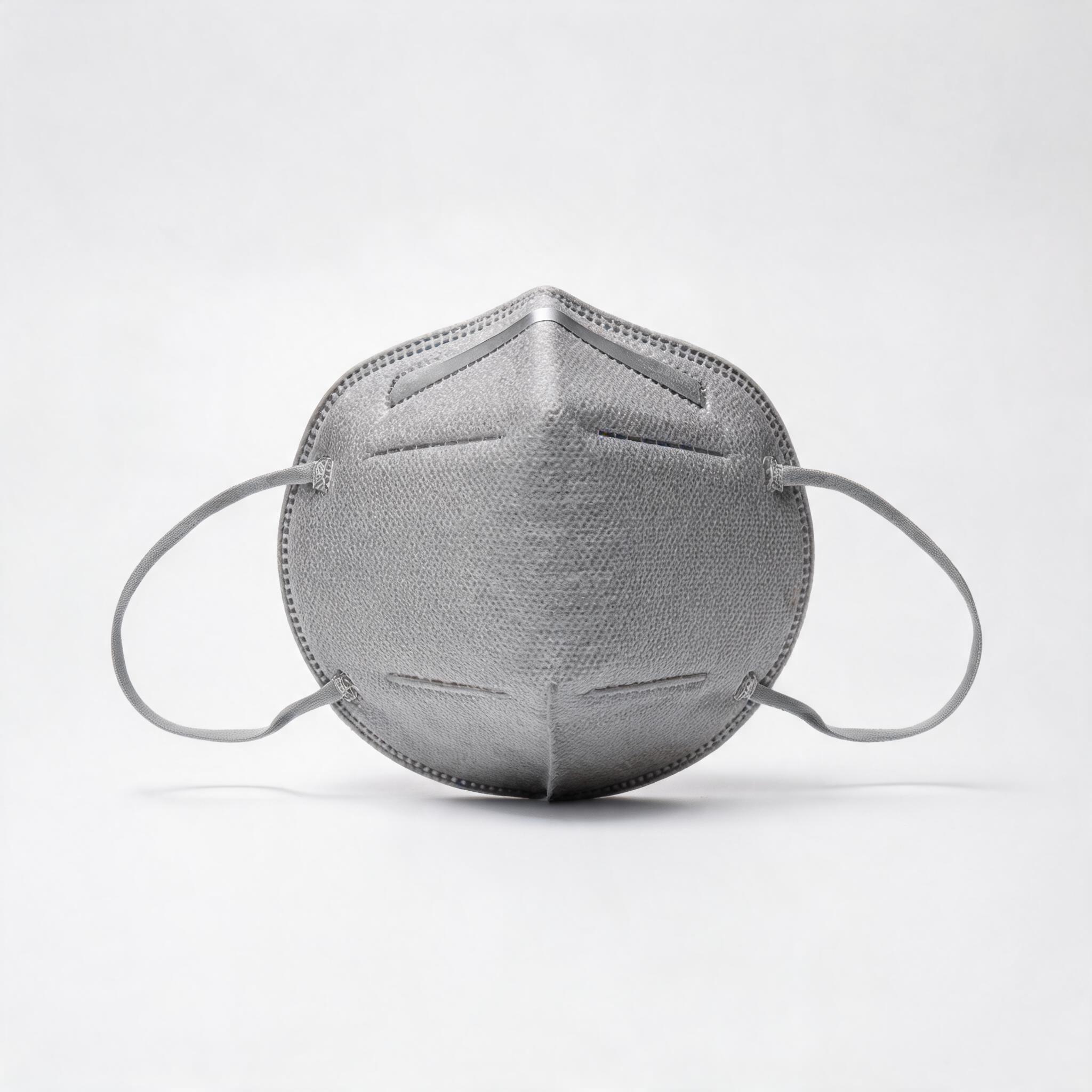
La résistance respiratoire est un paramètre de sécurité, et non une préférence de confort. Ce guide couvre les limites de résistance GB2626, les effets de la rétention de CO2, les facteurs déterminant la résistance, les protocoles de mesure et le lien entre la résistance et la conformité du porteur pour les équipes d'approvisionnement B2B.
KN95 Mask Inhalation Resistance: Breathing Resistance Standards and Their Impact on Worker Safety
Breathing resistance is the most misunderstood performance parameter in KN95 respirator procurement. While filtration efficiency dominates spec sheet comparisons, breathing resistance determines whether the respirator is actually wearable for the duration it is needed. A respirator that filters 99% of particles but creates such high breathing resistance that the wearer removes it after two hours provides less real-world protection than a 95% respirator that is worn comfortably for the full shift. This guide examines the inhalation and exhalation resistance requirements of GB2626-2006, how they affect wearer compliance, and what procurement teams should specify to ensure both protection and comfort.
Key principle: Breathing resistance is not a comfort preference - it is a safety parameter. High resistance causes CO2 retention, reduced oxygen intake, fatigue, and cognitive impairment, all of which create hazards in healthcare and industrial environments independent of respiratory protection.
GB2626 Breathing Resistance Requirements
The GB2626-2006 standard specifies maximum breathing resistance values for KN95 respirators at a standard flow rate of 85 L/min (representing moderate exertion breathing). These limits ensure that the respirator does not create excessive physiological burden on the wearer.
| Parameter | GB2626 Limit | Test Flow Rate | Significance |
|---|---|---|---|
| Inhalation resistance | <=350 Pa | 85 L/min | Primary comfort metric |
| Exhalation resistance | <=250 Pa | 85 L/min | CO2 clearance metric |
| CO2 dead space | <=1% | Standard | Rebreathing safety |
For comparison, NIOSH 42 CFR 84 (N95) limits inhalation resistance to 343 Pa and exhalation resistance to 245 Pa at 85 L/min - nearly identical to GB2626. EN 149 (FFP2) limits are slightly different at 70 Pa maximum at 30 L/min and 240 Pa at 95 L/min, reflecting different testing protocols.
How Breathing Resistance Affects Wearer Physiology
Breathing resistance creates physiological effects that directly impact worker safety and performance. Understanding these effects helps procurement teams justify specifying lower resistance values even when the GB2626 maximum is met.
CO2 Retention
When exhalation resistance is high, the wearer cannot fully exhale CO2 before the next inhalation. This causes CO2 to accumulate in the mask dead space (the air volume between the mask and face). Elevated CO2 levels cause:
- Headaches and dizziness (CO2 levels above 2%)
- Reduced cognitive function (CO2 levels above 3%)
- Nausea and impaired judgment (CO2 levels above 5%)
- Loss of consciousness (CO2 levels above 8%)
The GB2626 CO2 dead space limit of 1% is designed to prevent these effects, but masks operating near the limit with high exhalation resistance can approach dangerous CO2 levels during heavy exertion.
Respiratory Muscle Fatigue
High inhalation resistance forces the respiratory muscles to work harder with each breath. Over an 8-hour shift, this additional workload causes measurable respiratory muscle fatigue, reducing the wearer ability to maintain deep breathing and increasing the sensation of breathlessness. Studies show that respirators with inhalation resistance above 200 Pa cause noticeable fatigue after 4 hours, while those below 150 Pa can be worn for 8+ hours without significant fatigue.
Cognitive Performance Decline
Even mild CO2 elevation from high breathing resistance can impair cognitive performance. In healthcare settings, this means slower decision-making, increased error rates, and reduced situational awareness. In industrial settings, cognitive impairment from respirator use can increase accident risk.
Factors That Determine Breathing Resistance
Breathing resistance is not a single material property - it is the combined result of multiple design and material factors. Understanding these factors helps procurement teams identify which respirator designs will offer the best resistance-to-filtration ratio.
Meltblown Gram Weight and Density
As discussed in our meltblown gram weight guide, higher gram weight increases both filtration and breathing resistance. The key is finding the gram weight that achieves 95%+ PFE with the lowest possible resistance. For most KN95 applications, 30-40 gsm meltblown with high electrostatic charge provides the optimal balance.
Mask Structure and Breathing Chamber
Cup-style respirators create a breathing chamber between the mask and face, distributing airflow over a larger surface area and reducing resistance per unit area. Flat-fold designs that collapse against the face have higher effective resistance because the same airflow passes through a smaller effective filtration area. This is why the KN95 Cup Respirator typically achieves lower breathing resistance than flat-fold designs at equivalent filtration.
Exhalation Valve
The KN95 Valve Respirator dramatically reduces exhalation resistance by providing a dedicated one-way path for exhaled air that bypasses the filtration media. This reduces exhalation resistance by 60-80% compared to non-valved designs, making valved respirators the preferred choice for extended wear in warm environments or during physical exertion.
Electrostatic Charge Efficiency
Electrostatic charge allows the meltblown to capture particles without requiring high physical density. A well-charged meltblown at 30 gsm can achieve the same filtration as a poorly charged 45 gsm meltblown, but with 30-40% lower breathing resistance. This is why meltblown quality control that includes charge density measurement is critical for both filtration and resistance performance.
Measuring Breathing Resistance: Test Methods
Breathing resistance is measured using a differential pressure manometer connected to a test headform. The test headform has ports at the mouth position that measure the pressure difference between the ambient air and the air inside the mask at a controlled flow rate.
Standard Test Protocol
- Mount the respirator on the test headform, ensuring proper seal and positioning.
- Set the airflow to 85 L/min (simulating moderate exertion).
- Measure the pressure difference between ambient and mask interior - this is the inhalation resistance.
- Reverse the airflow direction to simulate exhalation.
- Measure the pressure difference again - this is the exhalation resistance.
Interpreting Results for Procurement
- Below 100 Pa inhalation: Excellent. Suitable for extended wear and high-exertion applications.
- 100-200 Pa inhalation: Good. Suitable for 6-8 hour wear in moderate-activity settings.
- 200-300 Pa inhalation: Acceptable. Suitable for 4-6 hour wear in low-activity settings.
- 300-350 Pa inhalation: Marginal. Meets GB2626 minimum but causes noticeable fatigue. Limit to short-duration use.
Breathing Resistance and Mask Compliance: The ROI Connection
The connection between breathing resistance and procurement ROI is direct: lower resistance means higher compliance, and higher compliance means the filtration investment is actually delivered. Breathability and comfort evaluation should be a standard part of supplier qualification, not an afterthought.
For 5-layer vs 4-layer comparison, breathing resistance is often the deciding factor. If a 5-layer design pushes breathing resistance above 250 Pa while a 4-layer design achieves 150 Pa with 95%+ PFE, the 4-layer design will deliver better real-world protection due to higher compliance.
Conclusion: Resistance as a Safety Specification
Breathing resistance is not a comfort preference that can be traded against cost - it is a safety specification that directly affects wearer physiology, cognitive performance, and compliance rates. Procurement teams that specify breathing resistance targets below the GB2626 maximum (targeting 150-200 Pa for inhalation) consistently achieve better real-world protection outcomes. The small cost premium of lower-resistance designs is recovered through higher compliance rates, reduced fatigue-related errors, and extended effective wear time per respirator.