
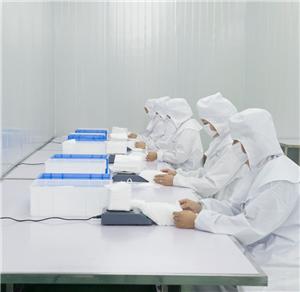
La qualité de la soudure des sangles est un facteur essentiel mais souvent négligé dans l'approvisionnement en masques KN95. Ce guide couvre les paramètres de liaison ultrasonique, les modes de défaillance courants, les normes de test et les points de contrôle des audits fournisseurs pour évaluer la qualité de fixation des sangles à grande échelle.
Quality Control Guide
KN95 Strap Welding Quality: Why Ultrasonic Bonding Determines Mask Integrity in Bulk Orders
When procurement teams source KN95 respirators at scale, the focus typically centers on filtration media, certification documents, and unit pricing. Yet one of the most common field failures in bulk KN95 orders is not filtration degradation-it is strap detachment. The welding quality that bonds the elastic strap to the mask body is a critical manufacturing variable that directly affects product usability, waste rates, and end-user safety. This guide examines the technical aspects of strap attachment in KN95 manufacturing and provides B2B buyers with a framework for evaluating welding quality during supplier audits.
Field failure reality: In bulk KN95 procurement, strap detachment accounts for an estimated 2-8% of unit waste in low-quality production batches. At container-load quantities, this translates to thousands of unusable units-representing a significant hidden cost that erodes the unit price advantage of lower-tier suppliers.
Ultrasonic Welding: The Industry Standard
Ultrasonic welding is the predominant method for attaching elastic straps to KN95 mask bodies. The process uses high-frequency mechanical vibrations (typically 20-40 kHz) applied under pressure to generate localized heat at the interface between the strap material and the mask body's nonwoven fabric. This heat melts the polymer at the contact points, creating a molecular bond without external adhesives or additional heat sources.
The key parameters that determine weld quality include:
- Frequency and amplitude: Higher amplitures generate more heat, which is necessary for thicker materials but can cause burn-through in lighter nonwovens.
- Pressure: Insufficient pressure results in weak bonds; excessive pressure can cut through the nonwoven or deform the strap.
- Dwell time: The duration of ultrasonic energy application. Too short produces cold welds; too long causes thermal degradation.
- Horn pattern: The engraved pattern on the welding horn (sonotrode) determines the bond point geometry. Common patterns include dot, line, and crosshatch configurations.
Weld Failure Modes in KN95 Production
Understanding how strap welds fail helps buyers identify quality issues before committing to bulk orders:
Cold Weld (Under-bonding)
Occurs when insufficient ultrasonic energy is applied, resulting in a bond that appears intact but separates under minimal force. Cold welds are the most common failure in high-speed production lines where cycle times are minimized to increase throughput. The strap holds during manufacturing QA but detaches during the first donning by the end user.
Burn-Through (Over-bonding)
Excessive energy melts through the nonwoven fabric, creating a hole at the attachment point. The strap may hold initially, but the surrounding material is weakened and tears under tension. Burn-through is visible as discoloration or small holes at the weld point.
Edge Cutting
The welding horn's edge can cut the elastic strap if the tooling is worn or misaligned. This creates a partial cut that acts as a stress concentrator, leading to premature strap failure during use.
Testing Strap Weld Strength: What B2B Buyers Should Specify
For supplier quality audits, strap weld strength should be a specified test parameter. The industry-standard test is a peel test, which measures the force required to separate the strap from the mask body.
| Test Parameter | Specification | Industry Benchmark |
|---|---|---|
| Peel Force (strap-to-body) | Minimum force before separation | ≥10 N per attachment point |
| Tensile Force (strap failure) | Force at which strap breaks | ≥30 N |
| Cycle Test (repeated donning) | Bond integrity after repeated stretching | ≥50 cycles at 50% elongation |
| Visual Inspection Rate | Percentage of units inspected for burn-through/edge cutting | AQL 2.5 or tighter |
Buyers should request these test results from the supplier's QC records and, where possible, conduct independent verification through third-party testing of random samples from production batches.
How Production Speed Affects Weld Quality
KN95 manufacturing lines operate at speeds ranging from 40 to 120 pieces per minute. Higher line speeds reduce unit cost but increase the risk of weld quality issues because each unit receives less ultrasonic energy exposure. The relationship between speed and quality is not linear-there is a threshold beyond which weld integrity degrades rapidly.
When evaluating suppliers, ask about their production line speed and how it relates to their welding parameters. Suppliers who can articulate the trade-off between speed and weld quality demonstrate process awareness. Suppliers who claim maximum speed with no quality compromise may not be monitoring weld strength closely.
Material Compatibility in Strap Welding
The weld quality depends not only on process parameters but also on material compatibility between the strap and mask body:
- Spandex-polyester elastic + PP nonwoven: The most common combination. Polypropylene nonwoven melts at approximately 160-170°C, while spandex melts at approximately 230°C. The ultrasonic energy must be calibrated to bond the PP without degrading the spandex.
- Latex-free elastic + SMS nonwoven: SMS (spunbond-meltblown-spunbond) has multiple layers with different melting characteristics, requiring more precise energy control.
- Knitted vs. braided elastic: Knitted elastics present more surface area for bonding but have lower tensile strength. Braided elastics are stronger but may have fewer contact points for the weld.
Supplier Audit Checklist for Strap Welding
When conducting a factory audit or evaluating reliable KN95 manufacturers, include these strap welding checkpoints:
- Welding equipment brand and model: Reputable brands (Branson, Herrmann, Dukane) indicate investment in quality tooling.
- Horn condition: Request to see the welding horn. Worn or damaged horns produce inconsistent welds.
- Production line speed: Compare against the supplier's claimed capacity. Speeds above 80 pcs/min warrant closer quality scrutiny.
- In-line QC inspection: Is there visual inspection of weld points on the production line? Automated vision systems are preferable to manual checks.
- Peel test frequency: How often does the supplier conduct peel tests? Best practice is every 30-60 minutes of production.
- Batch traceability: Can the supplier trace weld quality data to specific production batches?
- Reject rate data: What percentage of units are rejected for weld failures? A reject rate above 1% for strap issues suggests process control problems.
Procurement tip: Include strap weld peel strength as a line item in your purchase specification. A minimum peel force of 10 N per attachment point is a reasonable specification that filters out substandard manufacturers without imposing unrealistic requirements on quality suppliers.
The Cost of Poor Weld Quality at Scale
To illustrate the financial impact, consider a procurement scenario:
| Scenario | Order Quantity | Weld Failure Rate | Unusable Units | Cost at $0.30/unit |
|---|---|---|---|---|
| Quality supplier | 500,000 | 0.5% | 2,500 | $750 |
| Low-tier supplier | 500,000 | 5% | 25,000 | $7,500 |
| Difference | - | - | 22,500 | $6,750 hidden cost |
When the low-tier supplier offers a unit price that is $0.02 lower, the apparent savings of $10,000 are nearly eliminated by the $6,750 in weld failure waste. Add the cost of field complaints, potential safety incidents, and reputational damage, and the total cost of ownership clearly favors the quality supplier.
For procurement teams focused on complete supplier selection criteria, strap welding quality is a concrete, testable differentiator that separates manufacturers who invest in process control from those who prioritize speed over quality.
Conclusion
Strap welding quality is an underappreciated but critical factor in KN95 procurement. By understanding the welding process, failure modes, testing standards, and supplier audit checkpoints, B2B buyers can make more informed sourcing decisions that reduce waste, improve end-user satisfaction, and ensure that the respirators they purchase actually function as intended. Including strap weld specifications in purchase documents and verifying compliance through testing transforms this hidden quality variable into a managed procurement parameter.