
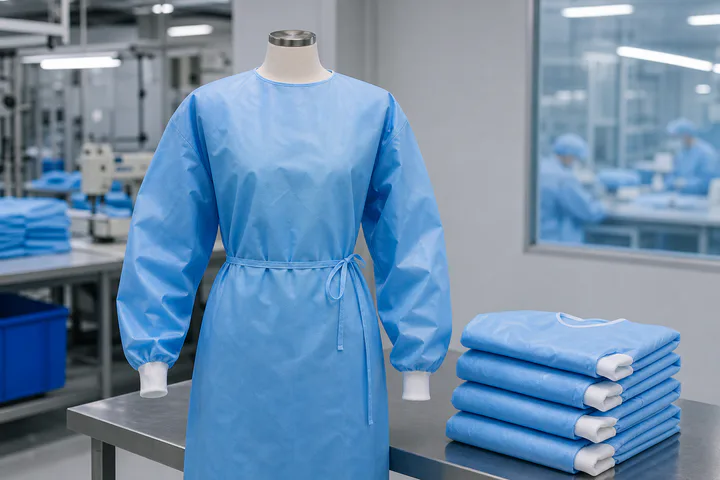
Confused about the difference between isolation gowns and surgical gowns for your next medical PPE procurement? This guide breaks down the key distinctions based on EN ISO 13795 standards, material composition, and application scenarios. Learn how to choose the right gown for your facility, avoid common purchasing mistakes, and ensure compliance with European regulations.
MEDICAL PPE PROCUREMENT GUIDE
• Isolation gowns and surgical gowns serve different risk levels: isolation gowns protect against low-to-moderate fluid exposure; surgical gowns protect against high-risk, sterile procedures.
• EN ISO 13795 is the harmonized European standard for surgical gowns, defining critical performance zones (A, B, C) and performance levels (1, 2, 3, 4).
• Material differences: surgical gowns typically use SMS (spunbond-meltblown-spunbond) or laminated fabrics; isolation gowns often use lightweight non-woven or reusable polyester.
• Procurement checklist: verify the standard version, check the performance level against your procedure, and confirm the packaging and sterilization requirements.
When you're sourcing medical protective apparel for a hospital, clinic, or healthcare facility, one of the first questions you'll face is: isolation gown vs surgical gown — what's the actual difference?
Both are classified as medical gowns, but they serve fundamentally different roles in infection control. The distinction matters for patient safety, for regulatory compliance, and for your procurement budget. This article explains the difference based on the EN ISO 13795 standard, the material construction, and the practical selection criteria that procurement professionals need to know.
What Is the EN ISO 13795 Standard?
EN ISO 13795 is the European harmonized standard for surgical gowns and surgical drapes. It replaced the earlier EN 13795 standard and aligns with the international ISO 13795. The standard specifies requirements for the performance of gowns used in surgical procedures, focusing on:
- Resistance to liquid penetration — both wet and dry conditions
- Microbial penetration resistance — in both wet and dry states
- Burst strength — mechanical integrity under stress
- Linting — particle release
- Cleanliness — microbial and particulate contamination
Importantly, EN ISO 13795 defines performance levels (1, 2, 3, 4) and critical zones (A, B, C) on the gown. The higher the level, the more protection the gown provides against liquid and microbial penetration.
Isolation gowns, on the other hand, are typically tested under EN 13795-1 (for general use) or the ASTM F2407 standard in North America, but they are not required to meet the same stringent performance criteria as surgical gowns. In Europe, isolation gowns are often classified as medical devices Class I or personal protective equipment (PPE) Category I or II, depending on the intended use.
Isolation Gown vs Surgical Gown: The Core Differences
Let's put the key differences side by side.
| Parameter | Isolation Gown | Surgical Gown |
|---|---|---|
| Primary purpose | Protect the wearer and patient from low-to-moderate fluid exposure; prevent cross-contamination | Maintain a sterile field during surgery; protect both patient and surgical team from high-risk fluid and microbial exposure |
| Applicable standard (EU) | EN 13795-1 (general), or as PPE under EN 14605/EN 14126; often not certified to surgical gown standard | EN ISO 13795 (surgical gowns); must meet defined performance levels |
| Performance levels | Typically lower (Level 1 or 2 by AAMI, or equivalent) | Level 1, 2, 3, or 4 (by EN ISO 13795 or AAMI PB70) |
| Critical zones | Not defined; single-zone protection | Defined zones A (front/sleeves), B (other areas), C (seams) |
| Sterility requirement | Often non-sterile; can be sterile for specific uses | Always sterile, individually packaged |
| Typical material | Lightweight non-woven (polypropylene SMS), polyester, or reusable cotton/polyester blends | Heavier SMS, laminated film (PE/PP), or microporous film; often reinforced |
| Typical applications | Patient isolation, standard precautions, blood draw, wound care, general ward use | Operating rooms, surgical procedures, invasive procedures |
| Cost per unit | Lower (€0.50–€2.00 for disposable, depending on volume) | Higher (€2.00–€10.00+ for disposable, depending on level and material) |
Material Differences: What You're Actually Buying
The material construction is one of the most visible differences between isolation gowns and surgical gowns. Here's what to look for when evaluating samples or supplier quotes.
Isolation Gown Materials
- Polypropylene (PP) SMS — The most common disposable isolation gown material. The spunbond layers provide strength, while the meltblown layer offers a barrier. Typical weight: 25–45 gsm. Good for fluid resistance at low pressure.
- Polyester / Cotton blends — Used in reusable isolation gowns. Can be laundered 50–100 times. Lower barrier performance unless treated with a water-repellent finish.
- PE (polyethylene) coated — Adds a waterproof layer on the front or sleeves. Often used for isolation gowns in high-risk areas like intensive care units (ICUs).
Surgical Gown Materials
- Reinforced SMS — Heavier weight (45–65 gsm) with additional meltblown layers. Used for Level 2–3 surgical gowns.
- Laminated film (PE/PP or microporous film) — Provides the highest barrier performance (Level 3–4). The film is laminated to a non-woven substrate. This material is impermeable to liquids and viruses.
- Reusable microporous fabrics — High-performance polyester or Gore-Tex-like laminates. Can be laundered 50–100 times. Higher upfront cost, but lower per-use cost for high-volume facilities.
Procurement tip: When comparing materials, always ask for the liquid penetration test results (hydrostatic pressure test) and the microbial penetration test results. A gown that looks similar may perform very differently. Don't rely on "looks like" — ask for the test report.
Performance Levels: What Do They Mean for Your Facility?
Under EN ISO 13795, surgical gowns are classified into four performance levels. The level you need depends on the procedure's risk of fluid exposure and microbial contamination.
| Level | Fluid Resistance | Typical Use | Example Procedure |
|---|---|---|---|
| Level 1 | Minimal | Low-risk, non-surgical | Minor wound care, blood draw |
| Level 2 | Low | Low-to-moderate risk | Sutures, drainage, endoscopy |
| Level 3 | Moderate | Moderate-risk surgery | Laparoscopy, orthopedic surgery |
| Level 4 | High | High-risk, heavy fluid exposure | Cardiovascular surgery, trauma |
Isolation gowns are typically equivalent to Level 1 or Level 2. They are not designed for high-risk procedures. If your facility is performing moderate-to-high-risk surgeries, you need surgical gowns certified to EN ISO 13795 at the appropriate level.
How to Choose: A Procurement Selection Guide
When you're sourcing gowns, follow this step-by-step process to avoid costly mistakes.
Step 1: Define the Use Case
What procedure or activity is the gown for? If it's a sterile surgical procedure, you need a surgical gown. If it's for patient isolation, standard ward use, or low-risk procedures, an isolation gown is sufficient.
Step 2: Check the Standard
Ask the supplier: Is this gown certified to EN ISO 13795? What is the performance level? For surgical gowns, the supplier should provide a declaration of conformity and a test report from a notified body (e.g., SGS, TÜV, BSI). For isolation gowns, check the PPE or medical device classification.
Step 3: Evaluate Material and Construction
- Request a material sample or swatch.
- Check the weight (gsm) and the number of layers.
- Ask about the seam construction — surgical gowns typically have taped or bonded seams to prevent fluid penetration at the weakest point.
- For reusable gowns, ask about the laundering protocol and the number of wash cycles the gown can withstand before performance degrades.
Step 4: Verify Sterility and Packaging
Surgical gowns must be sterile and individually packaged in a sterile barrier system. Isolation gowns are often non-sterile and packed in bulk (e.g., 50–100 per case). If you need sterile isolation gowns, specify that clearly in your RFQ.
Step 5: Compare Cost per Use, Not Cost per Unit
A reusable surgical gown may cost €15–€30 per unit, but if it can be laundered 100 times, the cost per use is €0.15–€0.30. A disposable Level 3 surgical gown may cost €3–€5 per use. The right choice depends on your volume, laundry capacity, and waste management policy.
Common Procurement Mistakes
- Using isolation gowns in surgical settings — This is a regulatory and safety risk. Isolation gowns are not tested for the same microbial and fluid penetration resistance as surgical gowns.
- Assuming all "non-woven" gowns are the same — The material weight, fabric construction, and barrier performance vary widely. Always ask for the standard and test report.
- Ignoring the packaging — If you need sterile gowns, verify that the packaging is intact and that the expiration date is clearly marked. Bulk-packed non-sterile gowns cannot be used in sterile fields.
- Over-specifying — Using a Level 4 surgical gown for a low-risk procedure increases cost unnecessarily. Match the gown to the procedure.
Frequently Asked Questions (FAQ)
Can an isolation gown be used as a surgical gown?
No. Isolation gowns are not tested to the same standard (EN ISO 13795) and do not provide the same level of barrier protection, especially in critical zones. Using an isolation gown in a surgical setting is a safety and regulatory risk.
What is the difference between EN ISO 13795 and AAMI PB70?
EN ISO 13795 is the European standard; AAMI PB70 is the North American standard. Both define performance levels (1–4), but the test methods and specific requirements differ. If you are sourcing for the European market, EN ISO 13795 is the required standard. For global supply, ask the supplier if the gown meets both standards.
Are reusable gowns more cost-effective than disposable ones?
It depends on the volume and the laundry cost. For a high-volume facility with an in-house laundry, reusable gowns can be more cost-effective over the long term. For smaller facilities or those without laundry capacity, disposable gowns are simpler and more predictable in cost.
How do I verify a supplier's EN ISO 13795 certification?
Request a copy of the Declaration of Conformity (DoC) and the test report from a notified body. The test report should include the specific performance level, the test methods used, and the date of testing. Cross-check the supplier's name and address on the document.
Conclusion: Make the Right Choice for Your Facility
The choice between isolation gowns and surgical gowns comes down to risk assessment. Define the procedure, check the regulatory requirements, and verify the supplier's certification. Don't cut corners on safety, but also don't overpay for protection you don't need.
When you're ready to source, work with a supplier who can provide clear documentation, material samples, and transparent pricing. Ask for a pre-shipment inspection to verify the quality and compliance before you commit to a large order.
For more information on medical PPE standards or to request a quote for isolation gowns or surgical gowns, contact our team.