
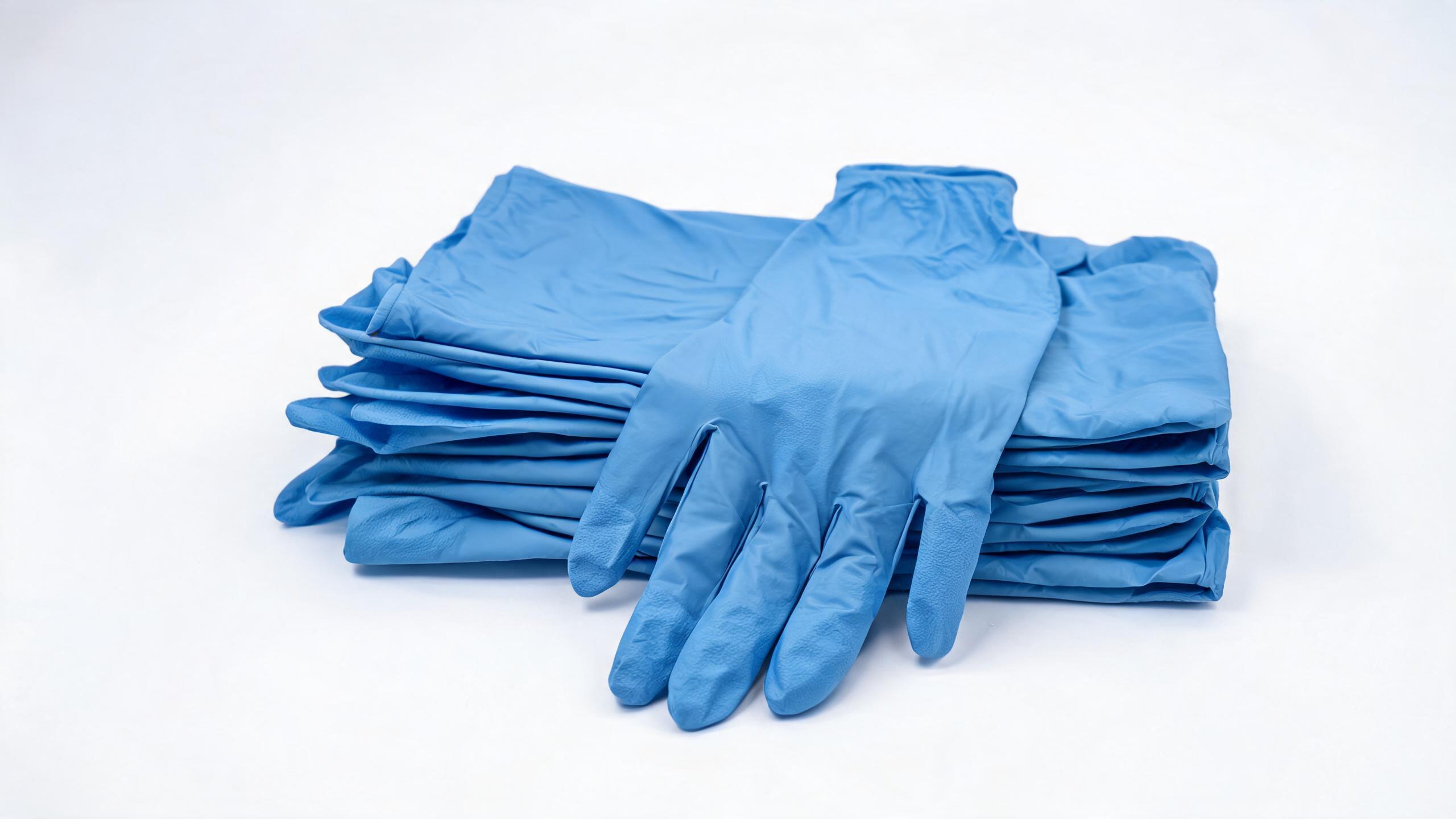
AQL 기준, 재질 선택(니트릴 대 라텍스 대 비닐), 두께 사양 및 인증 확인(EN 455, ASTM, FDA)을 다루는 의료 조달팀을 위한 일회용 의료용 장갑 품질 평가 실용 가이드입니다.
Healthcare Procurement Guide
Why Disposable Medical Glove Quality Evaluation Matters for Procurement
Healthcare procurement teams sourcing disposable medical gloves face a critical question: how do you distinguish a genuinely protective product from one that merely looks the part? The answer lies in three quantifiable parameters - AQL (Acceptable Quality Limit), material composition, and thickness - each of which directly impacts clinical safety, user comfort, and regulatory compliance. This guide breaks down what each metric means, how leading standards define acceptable thresholds, and what procurement professionals should verify before placing an order.
Key Takeaway: AQL 1.5 is the medical-grade threshold for examination gloves. Material choice (nitrile vs. latex vs. vinyl) determines allergy risk and chemical resistance. Thickness between 0.08–0.15mm balances protection and dexterity. Always request EN 455 or ASTM D6319 certification documentation from your supplier.
Understanding AQL: The Foundation of Glove Quality Assessment
AQL, or Acceptable Quality Limit, is the statistical benchmark used to measure the number of pinholes or defects allowable in a batch of gloves. It is not a marketing term - it is a regulated pass/fail criterion that determines whether a batch is safe for medical use. The lower the AQL number, the fewer defects are permitted, and the higher the quality.
AQL Levels and What They Mean
| AQL Level | Max Defects per 100 Units | Typical Application | Standard Reference |
|---|---|---|---|
| AQL 4.0 | 4.0 | Industrial, food handling | EN 455 / ASTM D5250 |
| AQL 2.5 | 2.5 | Food service, light cleaning | EN 455 Part 1 |
| AQL 1.5 | 1.5 | Medical examination, surgical | EN 455 / ASTM D6319 |
| AQL 0.65 | 0.65 | Surgical gloves (sterile) | EN 455 Part 2 |
For healthcare procurement, AQL 1.5 is the minimum acceptable level for examination gloves. Surgical gloves typically require AQL 0.65 or lower because they are used in sterile environments where even a microscopic pinhole can introduce pathogens into a surgical wound. When evaluating suppliers, ask for the AQL test report for each batch - reputable manufacturers conduct pinhole testing per ISO 2859-1 sampling protocols and can provide batch-specific documentation.
How AQL Testing Works in Practice
AQL testing follows a statistically valid sampling plan. For a production batch of 100,000 gloves, a random sample (typically 200–315 units) is tested using a water leak test - each glove is filled with 1 liter of water and inspected for leaks within two minutes. If the number of defective units in the sample exceeds the acceptance number defined by the sampling plan, the entire batch is rejected. This means that AQL 1.5 does not guarantee zero defects - it means that the statistical probability of defects is controlled to a level deemed safe for medical use.
Material Selection: Nitrile vs. Latex vs. Vinyl
The material of a medical glove determines its protective properties, comfort, and suitability for different clinical tasks. Three materials dominate the market:
Nitrile Gloves
Nitrile (a synthetic rubber copolymer of acrylonitrile and butadiene) has become the preferred material for medical examination gloves. Key properties include:
- Latex-free: Eliminates Type I IgE-mediated allergic reactions, which affect an estimated 8–17% of healthcare workers regularly exposed to latex
- Chemical resistance: Superior resistance to oils, solvents, and many chemotherapy drugs compared to natural rubber latex
- Puncture resistance: Nitrile has approximately 3–5 times the puncture resistance of latex of equivalent thickness
- Tactile sensitivity: Modern nitrile formulations achieve sensitivity comparable to latex while maintaining barrier integrity
- Shelf life: Typically 3–5 years in proper storage conditions, compared to 3 years for latex
For Justsun's nitrile examination gloves, the material is 100% latex-free with an AQL 1.5 medical-grade rating, EN 455 certification, and a powder-free textured surface for enhanced grip in clinical settings.
Natural Rubber Latex Gloves
Latex offers excellent elasticity and tactile sensitivity but carries the risk of Type I allergic reactions. Latex gloves remain relevant for surgical procedures where maximum dexterity is required and where the user has confirmed no latex sensitivity. Sterile latex gloves are individually packaged in pairs and typically carry AQL 1.5 or lower certification.
Vinyl Gloves
Vinyl (PVC) gloves are the least expensive option but offer the lowest barrier protection and tensile strength. They are suitable only for short-duration, low-risk tasks such as routine patient contact or food preparation. Vinyl gloves are not recommended for procedures involving sharp instruments, chemicals, or extended wear.
| Property | Nitrile | Latex | Vinyl |
|---|---|---|---|
| Puncture resistance | Excellent | Good | Fair |
| Chemical resistance | Excellent | Good | Poor |
| Allergy risk | None (Type I) | High (Type I) | Low |
| Tactile sensitivity | Good | Excellent | Fair |
| Typical AQL | 1.5 | 1.5 | 2.5–4.0 |
| Best for | Examination, lab work | Surgical procedures | Short, low-risk tasks |
Glove Thickness: Balancing Protection and Dexterity
Thickness is measured in millimeters or mils (1 mil = 0.0254mm) and is typically reported as a range because glove thickness varies between fingers and palm. The thickness you need depends on the intended use:
- 0.08–0.10mm (3–4 mil): Thin examination gloves optimized for tactile sensitivity. Suitable for routine patient examination, phlebotomy, and dental procedures
- 0.10–0.12mm (4–5 mil): Standard examination thickness balancing protection and dexterity. This is the most common range for general medical use
- 0.12–0.15mm (5–6 mil): Enhanced barrier protection for procedures with higher fluid exposure risk or extended wear durations
- 0.15mm+ (6+ mil): Heavy-duty gloves for chemical handling, chemotherapy drug preparation, or industrial applications
For reference, Justsun's powder-free nitrile examination gloves are manufactured at 0.11mm thickness - positioned in the standard examination range that balances barrier protection with the tactile sensitivity needed for clinical tasks.
Certification Standards to Verify Before Purchasing
Procurement teams should request and verify the following documentation before committing to a glove purchase:
EN 455 Series (European Market)
The EN 455 standard is the primary European regulation for medical gloves. It consists of four parts:
- EN 455-1: Requirements and testing for freedom from holes (pinhole leak test, AQL-based)
- EN 455-2: Requirements and testing for physical properties (dimensions, tensile strength, elongation)
- EN 455-3: Requirements and testing for biological evaluation (cytotoxicity, irritation, sensitization)
- EN 455-4: Requirements and testing for shelf-life determination (accelerated aging and real-time stability)
ASTM Standards (US Market)
For the US market, the relevant ASTM standards are:
- ASTM D6319: Standard specification for nitrile examination gloves
- ASTM D3578: Standard specification for rubber examination gloves (latex)
- ASTM D5250: Standard specification for polyvinyl chloride (PVC) gloves
Additionally, gloves sold in the US for medical use require FDA 510(k) clearance. For the European market, gloves require CE marking with a Notified Body number. Always cross-reference the CE mark number on the product packaging with the notified body database to confirm authenticity.
Common Quality Pitfalls in Glove Procurement
Even when a supplier claims compliance, procurement teams should watch for these common issues:
- Understated defect rates: Some suppliers report AQL based on pre-shipment sampling rather than production-line testing. Request both sets of data for comparison
- Inconsistent thickness: Gloves may meet minimum thickness specs at the palm but fall short at the fingers. Ask for thickness measurements at multiple points
- False certification claims: Counterfeit CE marks and FDA registrations exist. Verify the 4-digit notified body number and FDA registration number through official databases
- Powder residue on "powder-free" gloves: True powder-free gloves use a chlorination or polymer coating process. Test for residual powder using the ASTM D6124 method
- Shelf-life exaggeration: Accelerated aging tests can predict shelf life, but real-time stability data should eventually confirm it. Request EN 455-4 compliance documentation
Pre-Shipment Quality Inspection Checklist
Before accepting a glove shipment, procurement teams should verify the following items:
| Checkpoint | What to Verify | Acceptance Criteria |
|---|---|---|
| Certification documents | EN 455 / ASTM / FDA 510(k) certificates | Valid, current, matching product specification |
| AQL test report | Batch-specific pinhole test results | AQL ≤ 1.5 for medical examination |
| Thickness measurement | Measurement at palm and fingertip | Within specified range (±0.02mm tolerance) |
| Tensile strength | Before and after accelerated aging | ≥ 14 MPa (nitrile), ≥ 21 MPa (latex) |
| Visual inspection | Random sample of 50 units | No tears, pinholes, or contamination |
| Packaging integrity | Seal inspection, sterile packaging where applicable | No compromised seals, correct labeling |
| Labeling compliance | CE mark, lot number, expiry date, storage conditions | All required elements present and legible |
Procurement Tip: When evaluating a new supplier, request a pre-production sample lot (500–1,000 units) for independent third-party testing before committing to volume orders. The cost of testing is minimal compared to the risk of deploying substandard gloves in a clinical setting.
Frequently Asked Questions
What AQL level is required for medical examination gloves?
AQL 1.5 is the standard requirement for medical examination gloves under EN 455 and ASTM D6319. This means no more than 1.5% of gloves in a statistically valid sample may have pinholes. Surgical gloves typically require AQL 0.65 or lower for sterile use.
Are nitrile gloves safer than latex gloves for healthcare workers?
Nitrile gloves eliminate the risk of Type I latex allergy, which affects a significant percentage of healthcare workers. They also offer superior puncture and chemical resistance. However, latex may still be preferred for surgical procedures requiring maximum tactile sensitivity, provided the user has no latex sensitivity.
What thickness should medical examination gloves be?
For general medical examination, a thickness of 0.08–0.12mm (3–5 mil) is standard. Thinner gloves (0.08mm) prioritize tactile sensitivity for procedures like phlebotomy, while thicker gloves (0.12mm+) provide enhanced barrier protection for higher-risk tasks.
How can I verify that a supplier's CE certification is genuine?
Check the 4-digit notified body number on the CE mark against the NANDO (New Approach Notified and Designated Organisations) database on the European Commission website. The FDA registration number can be verified through the FDA's Medical Device Establishment Registration database.
What is the difference between sterile and non-sterile examination gloves?
Sterile gloves undergo a validated sterilization process (typically gamma irradiation or ethylene oxide) and are individually packaged in pairs to maintain sterility until use. They are required for surgical procedures. Non-sterile examination gloves are suitable for routine patient contact and general clinical tasks.
How should disposable medical gloves be stored?
Store gloves in their original packaging in a cool, dry place away from direct sunlight, fluorescent light, and heat sources. Recommended storage temperature is 10–30°C with relative humidity below 80%. Do not store near solvents, oils, or UV-emitting equipment, as these degrade glove materials.
What is the typical shelf life of nitrile examination gloves?
Nitrile examination gloves typically have a shelf life of 3–5 years when stored under proper conditions. The expiry date should be printed on the packaging. Shelf life is validated through EN 455-4 accelerated aging and real-time stability testing.
Can powder-free gloves still have residual powder?
True powder-free gloves manufactured via chlorination or polymer coating should have minimal residual powder (typically less than 2mg per glove). However, incomplete processing can leave higher residues. The ASTM D6124 test method quantifies residual powder levels for compliance verification.
Conclusion: Building a Reliable Glove Sourcing Process
Effective medical glove procurement requires moving beyond price comparison to a structured quality evaluation process. By verifying AQL compliance, selecting the appropriate material and thickness for the intended use, and validating certification documentation through official databases, procurement teams can significantly reduce the risk of deploying substandard protective equipment in clinical settings.
For healthcare facilities sourcing from China-based manufacturers, working with suppliers who maintain CE and FDA certifications, provide batch-specific AQL test reports, and support pre-shipment quality inspections is essential for maintaining supply chain integrity and protecting frontline healthcare workers.
Need Certified Medical Gloves for Your Facility?
Request specifications, AQL test reports, and pricing for our EN 455-certified nitrile examination gloves.
View Product Specifications