
Technical guide explaining CO2 dead space and breathing resistance in KN95 respirators, their physiological effects on wearers, testing standards under GB2626-2006, and how B2B buyers can evaluate comfort parameters for procurement decisions.
Technical Guide · Respiratory Physiology
CO2 Dead Space and Breathing Resistance: What B2B Buyers Must Understand About KN95 Respirators
When procurement teams evaluate KN95 respirators, they typically focus on filtration efficiency, certification status, and unit price. However, two physiological parameters-CO2 dead space and breathing resistance-directly determine whether end users will actually wear the respirator correctly for the full duration of their shift. A mask with excellent filtration but unacceptable breathing resistance or CO2 buildup will be removed, adjusted, or worn improperly, negating its protective function entirely.
This guide explains the science behind CO2 dead space and breathing resistance in KN95 respirators, the relevant testing standards, and what B2B buyers should look for in supplier test data to ensure both protection and wearer compliance.
Why this matters: Studies show that up to 40% of respiratory protection failures are due to wearer non-compliance, not filter failure. The leading causes of non-compliance are heat buildup, breathing discomfort, and CO2 accumulation-all consequences of dead space and resistance design parameters that are quantifiable and verifiable before purchase.
What Is CO2 Dead Space in a Respirator?
Dead space refers to the volume of air trapped between the respirator surface and the wearer's face that is rebreathed with each respiratory cycle. This trapped air contains elevated CO2 levels (typically 2–5% compared to 0.04% in ambient air) and reduced oxygen compared to fresh air. With each breath, the wearer inhales a mixture of fresh air and this CO2-enriched dead space air.
For KN95 mask breathability, dead space volume is a critical design consideration. The larger the dead space, the more CO2 the wearer rebreathes. Two factors primarily determine dead space volume:
- Mask geometry: Cup-style respirators with a rigid shell typically have larger dead space (30–50 mL) compared to flat-fold designs (15–30 mL), because the cup shape holds the filter material farther from the face.
- Fit and seal quality: A poorly fitting mask with gaps creates additional effective dead space as exhaled air is trapped in the leak paths rather than being expelled.
CO2 Accumulation: Physiological Effects
The human body is sensitive to elevated CO2 in inhaled air. The following table summarizes the physiological response at different inhaled CO2 concentrations:
| Inhaled CO2 Level | Physiological Effect | Impact on Worker Performance |
|---|---|---|
| 0.04% (ambient) | Normal | No effect |
| 1–2% | Slight increase in breathing rate | Minimal; most wearers adapt |
| 2–3% | Noticeable breathing discomfort, mild headache after 30+ minutes | Reduced concentration in extended-use scenarios |
| 3–5% | Significant breathing distress, headache, sweating | Workers remove or adjust masks, breaking seal |
| 5%+ | Dangerous CO2 exposure; dizziness, confusion | Unacceptable for any work environment |
Well-designed KN95 respirators typically maintain inhaled CO2 below 2% during normal activity. However, during heavy exertion or extended wear (4+ hours), CO2 levels can climb toward the 2–3% range, particularly in cup-style designs with larger dead space.
Breathing Resistance: The Other Side of Comfort
Breathing resistance is the pressure drop the wearer must overcome to draw air through the filter material. GB2626-2006 specifies maximum resistance values that all certified KN95 respirators must meet:
| Parameter | GB2626-2006 Limit | Measurement Condition | Significance |
|---|---|---|---|
| Inhalation resistance | ≤350 Pa | 85 L/min airflow | Effort required to inhale through the filter |
| Exhalation resistance | ≤250 Pa | 85 L/min airflow | Effort required to exhale through the filter |
These limits represent the maximum allowable values. However, masks at the limit (e.g., 340 Pa inhalation) feel noticeably harder to breathe through than masks at 150–200 Pa. For KN95 breathing resistance, the difference between a comfortable mask and one that workers reject often comes down to where in the acceptable range the product sits.
Factors That Affect Breathing Resistance
- Filtration media density: Higher meltblown grammage (gsm) improves filtration but increases resistance. Manufacturers must balance these competing demands.
- Effective filtration area: A larger filter area distributes airflow across more material, reducing per-area resistance. Cup-style respirators typically have a larger effective area than flat-fold masks, partially offsetting their larger dead space.
- Electrostatic charge: Charged meltblown achieves the same filtration efficiency at lower material density, reducing breathing resistance. This is why electrostatic-treated meltblown is the industry standard for KN95.
- Moisture accumulation: As the wearer exhales, moisture condenses on the filter material, gradually increasing resistance over the wear period. A mask that starts at 180 Pa may reach 300+ Pa after 4 hours of use.
The Valve Solution: Reducing Exhalation Resistance and CO2 Buildup
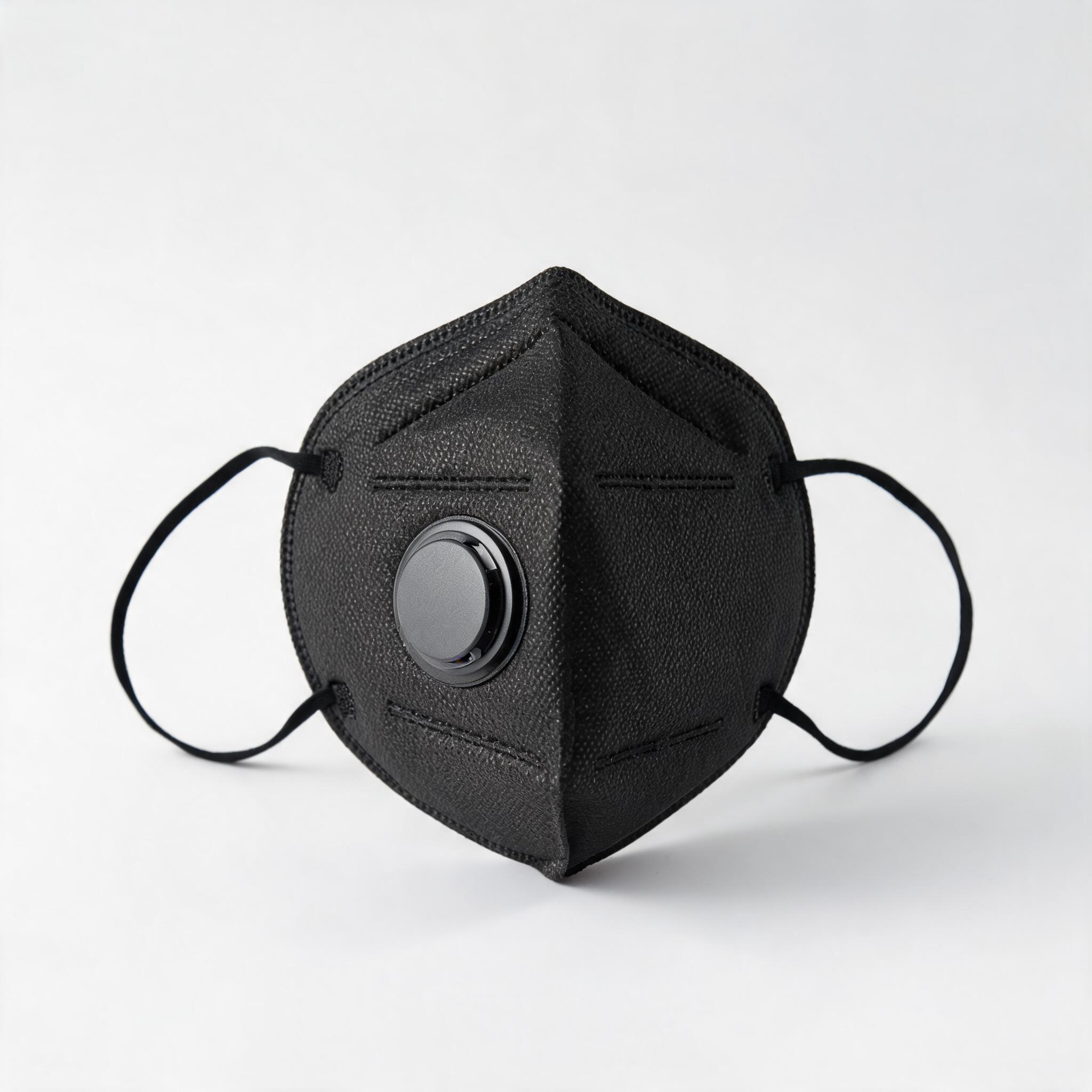
One engineering solution to both exhalation resistance and CO2 dead space is the exhalation valve. A valved KN95 respirator incorporates a one-way mechanical valve that opens during exhalation, allowing warm, CO2-rich air to exit directly without passing through the filter material. During inhalation, the valve seals shut, forcing all incoming air through the filtration layers.
The valve provides two benefits:
- Reduced exhalation resistance: Exhaled air meets minimal resistance, dropping from 150–250 Pa to near-zero.
- Reduced dead space CO2: With each exhalation, most trapped CO2 is vented rather than retained in the dead space.
- Reduced heat and moisture: Warm, moist exhaled air is expelled, keeping the mask interior cooler and drier.
Important caveat: Valved respirators protect the wearer but do not provide source control-the valve allows unfiltered exhaled air to escape. In healthcare settings where protecting others from the wearer is required, valved respirators may be inappropriate unless covered by a surgical mask. Check local regulatory requirements before specifying valved respirators for clinical use.
Testing and Verification: What to Ask Your Supplier
Breathing resistance and CO2 dead space are quantifiable parameters. B2B buyers should request the following test data from their KN95 supplier:
1. Inhalation and Exhalation Resistance Test Report
This report should be conducted per GB2626-2006 Appendix C (or equivalent), testing at 85 L/min continuous airflow. The report should show actual measured values, not just pass/fail confirmation. A mask that tests at 180 Pa inhalation and 120 Pa exhalation will be significantly more comfortable than one testing at 340 Pa and 240 Pa-even though both technically pass.
2. CO2 Concentration Test (if available)
Some advanced testing laboratories can measure inhaled CO2 concentration during simulated breathing. EN 149 (the European FFP2 standard) references a maximum CO2 dead space requirement, and some KN95 manufacturers voluntarily test to this parameter. If available, this data provides direct evidence of wearer comfort performance.
3. Respirator performance testing Data
The complete test report should include not only filtration efficiency but also resistance values, valve leak rate (for valved models), and visual inspection results. Request the full report, not just a summary certificate.
Design Features That Reduce Dead Space and Resistance
When evaluating different KN95 products, look for these design features that improve breathing comfort:
- Structured 3D design: Masks that maintain a tented shape away from the mouth and nose create a defined breathing chamber. This design is common in cup-style respirators and structured flat-fold variants.
- Multi-layer optimization: Not all five layers need to be high-density filtration. A well-designed KN95 uses a single dense meltblown layer for filtration, with lighter layers for support and comfort, reducing overall resistance.
- Large filter surface area: Masks with deeper pleats or wider face coverage distribute airflow over more material, reducing per-unit-area load.
- Exhalation valve (where appropriate): For industrial and non-source-control applications, a valve dramatically improves exhalation comfort.
Practical Implications for Different Use Cases
Healthcare (Extended Wear, 6–8 Hours)
Healthcare workers wearing respirators for full shifts are the most sensitive to CO2 buildup and breathing resistance. For this population, prefer respirators with measured inhalation resistance below 200 Pa and consider structured designs that maximize dead space ventilation. The ear loop vs headband design also matters-headband-style respirators typically achieve a better seal with less tension, reducing facial fatigue during extended wear.
Industrial (High Exertion)
Construction, mining, and manufacturing workers generate higher breathing volumes and rates. For these applications, valved respirators are strongly recommended. The valve reduces exhalation resistance, allowing workers to maintain physical output without the mask becoming the limiting factor.
Public Health Distribution (Short Duration, Variable Compliance)
For public health programs distributing respirators to the general public, comfort is paramount because users have no training or enforcement. Lower-resistance designs with good dead space management will see higher compliance rates, which is more valuable than marginal filtration improvement that users reject.
Conclusion: Balance Filtration With Wearability
Filtration efficiency is the headline specification, but CO2 dead space and breathing resistance determine real-world effectiveness. A respirator that filters 99% of particles but is removed after 30 minutes due to breathing discomfort provides less protection than a 95%-efficient respirator worn correctly for the full shift.
By understanding the physics of dead space and resistance, requesting relevant test data from suppliers, and matching respirator design to the intended use case, B2B buyers can select products that deliver both protection and compliance-the combination that actually keeps end users safe.
Need help evaluating breathing resistance data for your KN95 procurement? Our team can provide full test reports, CO2 dead space analysis, and product recommendations matched to your end users' work environment and wear duration.