
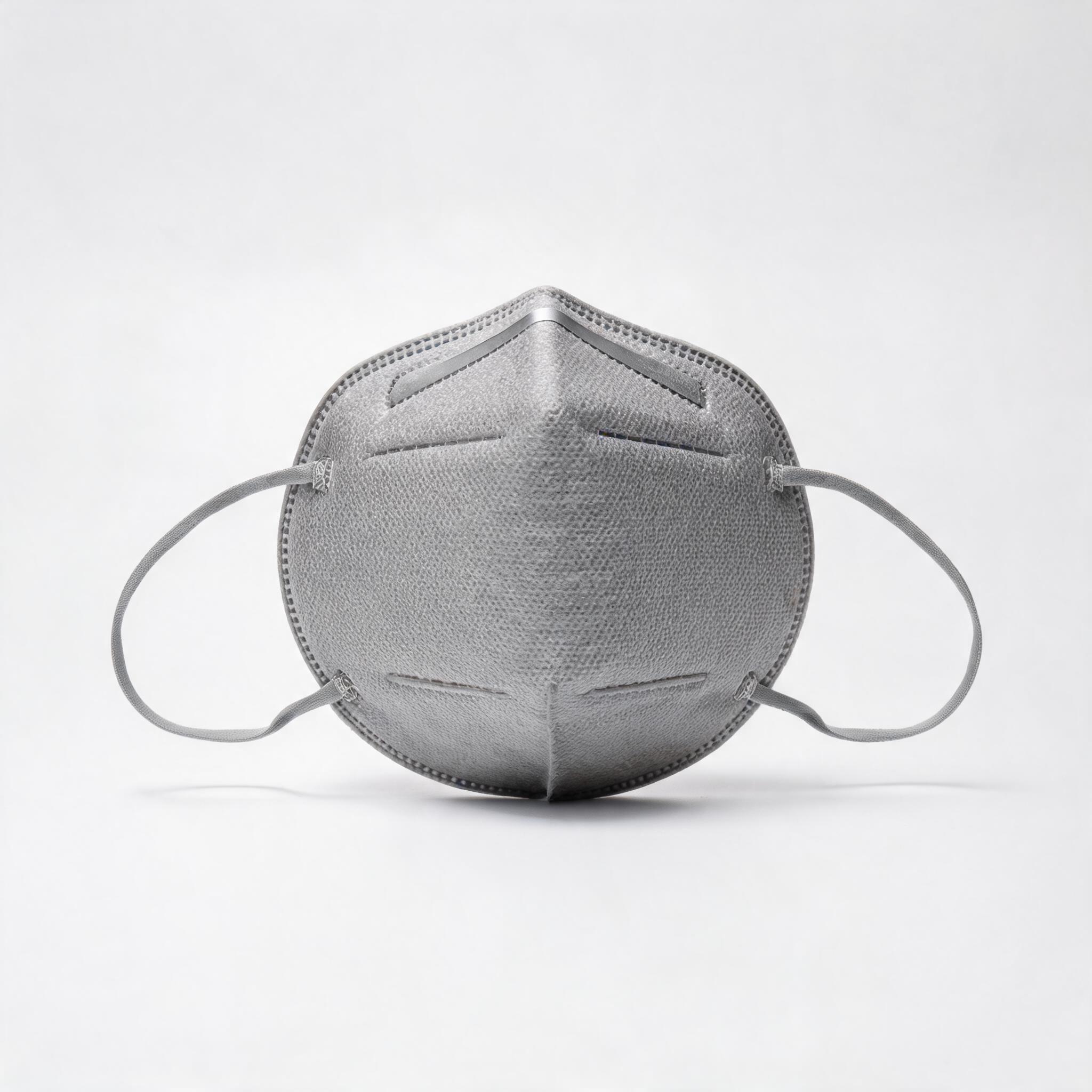
A procurement and warehouse-compliance walkthrough for one rigid grey cup KN95 line item: the fields to lock into the PO spec sheet, how dual adjustable head straps behave across a mixed head-size workforce, inner-box and carton questions to settle before ordering, and a ten-minute incoming inspection checklist for bulk receipts.
Most of the cost of a bad respirator purchase is not paid at the invoice. It is paid when a mixed pallet arrives, the warehouse cannot reconcile quantity against the packing list, the staff who open the first box find the head straps do not adjust far enough for the people who need them, and the buying office discovers the purchase order said "KN95, grey" and nothing else. The supplier shipped what the PO described. The dispute is about the PO, not the goods, and that is the expensive kind.
This article is written for the single-SKU case: one rigid grey cup KN95 respirator, ordered in bulk, shipped to a hospital store, a distributor warehouse or a government stockpile program. It covers what to write into the spec sheet before the order, how fit behaves across a large workforce of mixed head sizes, what to settle about inner boxes and cartons, and how to inspect a receipt in about ten minutes. Colour is treated here as what it is: a stock-control and identification factor, not a performance claim.
In this article
- What a grey cup KN95 line item is, and where it belongs on a purchase list
- The spec-sheet fields worth locking into the PO
- Head-size fit and what dual adjustable straps mean for a mixed workforce
- Inner-box and carton questions to settle before ordering
- A ten-minute incoming inspection checklist
- When a different format is the better line item
- Frequently asked buyer questions
What a grey cup KN95 line item is, and where it belongs on a purchase list

The Justsun grey cup KN95 is a rigid cup-style respirator: a thermoplastic cup shell forming the body, with a meltblown nonwoven filter medium inside, a sealed perimeter edge, a soft foam inner lining and dual adjustable head straps. Filtration is declared at 95 percent or better at 0.3 micrometre, declared to GB2626-2006 with CE marking. Unit weight is about 4.5 g, packing is 50 pieces per inner box, and the rated continuous use is 8 hours.
On a purchase list, this is a stock-position item rather than a project item. It sits in the same category as other respirator line items that a hospital store, a distributor's PPE catalogue or a stockpile roster keeps at a defined minimum quantity and replenishes on a cycle. It is not a fit-dependent specialty item, because there is no sizing to select: one cup size is what the line offers, which is exactly why the strap adjustment range and the PO description matter more than they would on a product with multiple sizes.
The grey body does practical work in that stock position. If your facility also holds the same cup model in white, a second colour gives you a visual distinction between two otherwise identical-looking boxes on a shelf, and a fast way to confirm at receiving that the pallet in front of the inspector is the SKU the PO called for. That is an identification benefit only. Colour does not change the declared filtration, the weight, the strap design or the packing quantity.
Justsun manufactures disposable medical supplies and protective nonwoven products in a facility of over 26,100 square metres with more than 400 employees. For a bulk buyer, the useful part of that is continuity of a single line item across repeat orders, not a differentiator you can inspect in a box. What you can inspect is in the checklist further down.
The spec-sheet fields worth locking into the PO

Loose wording causes disputes because it moves the argument to interpretation. "KN95 respirator, grey, 50 per box" leaves the model, the declared standard, the weight, the strap type, the markings and the packing description open. The table below lists the fields worth fixing in writing, with the reason each one earns its line.
| Field | What to write | Why it earns a line in the PO |
|---|---|---|
| Product identification | Manufacturer name, line item name, colour (grey), reference to the supplier's product page or code | Settles which line item was ordered when a supplier offers more than one cup model in more than one colour |
| Style | Rigid cup, non-foldable | Prevents a substitution with a flat-fold item on the grounds that both are "KN95" |
| Structure | Thermoplastic cup shell, meltblown nonwoven filter medium, soft foam inner lining, sealed perimeter edge | Gives the inspector something to look at and the buyer something to point at |
| Declared filtration | 95 percent or better at 0.3 micrometre | The core performance declaration; must appear as the supplier states it, not as a paraphrase |
| Declared standard and marking | Declared to GB2626-2006, CE marked | The compliance basis of the line item as the supplier declares it |
| Fastening | Dual adjustable head straps | Bar-strap and earloop versions exist elsewhere; a substitution here is a fit failure for the wearer |
| Unit weight | About 4.5 g per unit | Useful as a rough weight reconciliation on receipt; not a substitute for a piece count |
| Inner packing | 50 pieces per inner box; state inner-box labelling and bagging requirements | Drives the count the warehouse actually performs at receiving |
| Carton | Carton quantity, dimensions, gross weight, labelling, pallet pattern — all as confirmed with the supplier at inquiry | Prevents a carton-planning surprise at the loading dock rather than on the drawing board |
| Rated use period | 8 hours of continuous use | Anchors any change-out schedule your facility builds around the item |
| Documentation | Which documents ship with the consignment, and in what form | Avoids discovering at the border that a document you assumed was included was not |
| Commercial terms | MOQ, price, lead time, shelf life, delivery terms — all as confirmed with the supplier at inquiry | These are not fixed values in this article; they are parameters of your specific order and must be agreed in writing |
Two of those rows are worth more comment than the table allows. The first is the standard declaration. Write it as the supplier states it, with the exact standard number and the marking, and do not upgrade the wording in your own PO — a buyer who types "N95" into a PO for a GB2626-2006 line item has created a document the supplier cannot truthfully sign against. The second is the documentation row. Decide before ordering whether you need the compliance documentation as a physical insert, as a file, or both, and write that into the PO. Reconstructing that requirement after the containers are on the water is always slower.
If you are specifying this line item for the first time, the grey cup KN95 respirator page is the reference the PO should point to, so that both sides are describing the same object.
Head-size fit and what dual adjustable straps mean for a mixed workforce
There is no size run on this item. One cup size, and the fit range is carried by the straps and the shell geometry. Dual adjustable head straps are the reason a single-size cup can serve a mixed workforce: two independent straps, one passing above the crown and one below, each adjustable, let the wearer tension the cup against the face at two points rather than one. A single-strap or earloop design has one adjustment and one anchor, which is a much narrower fit window across a population that ranges from small to large heads.
For a procurement manager, the practical question is not "does it fit" but "what fraction of the workforce can we expect to be served by this single size, and what do we do about the remainder". Answering that from a spec sheet alone is not possible. It is answered by fit trials, and the useful thing to ask the supplier at inquiry is not whether the item "fits everyone" but what fit support they can provide: sample units for a pre-purchase fit trial, guidance on correct donning and strap tensioning, and whether donning instructions ship with the product for the facility to display.
A pre-purchase fit trial for a large workforce does not need to be elaborate to be informative. A panel that deliberately includes the smallest and largest head sizes on staff, plus anyone who has previously failed a cup-style respirator, tells you more than a random sample of convenience. If you operate a formal respiratory protection program with fit testing, treat the fit test as your facility's own procedure under your own program; the supplier's role is to supply consistent units and the adjustment range and instructions that let your procedure work. Ask at inquiry which document formats the supplier can provide for your records, and be specific: the document you need depends on the program you run.
The 8-hour rated use period interacts with fit in a way worth planning for. A cup that is comfortable for the first hour can become a compliance problem by hour six if the wearer loosens the lower strap to relieve pressure. Foam lining at the inner edge and a sealed perimeter help here, but the change-out schedule your facility sets should reflect the rated 8 hours and the realities of the task, not just the shift length. Where a single continuous wear period exceeds the rating, plan for replacement rather than extension.
One more fit point that belongs in the PO rather than the fit trial: the strap type. If your workforce currently uses an earloop product and you are moving a segment to head straps, that is a training change, not just a stock change. The headband respirator line is where to look if you need the same fastening principle in a different product format for comparison during the transition.
Inner-box and carton questions to settle before ordering
Inner packing is the layer where warehouse compliance teams spend their time. The confirmed figure for this item is 50 pieces per inner box. Everything a receiving team needs to reconcile against — the count they perform, the label they scan, the bag they open — is built on that 50, and the carton quantity sits on top of it.
Settle these before the PO is issued, and get the answers in writing:
- Inner-box labelling. What is printed on the inner box, and is the lot or batch reference readable without opening it? A warehouse that has to break a seal to find a batch number will do it, and then the box is open stock.
- Bagging inside the inner box. Whether the 50 pieces are loose or bagged, and whether the bag is resealable, changes how a partially issued inner box is handled on the ward or at the issue window.
- Carton quantity and carton marks. Confirm with the supplier at inquiry; the carton count, the marking format and the placement of the marks all need to be agreed, because your warehouse may have its own label to apply over or beside the supplier's.
- Carton dimensions and gross weight. Confirm with the supplier at inquiry. These determine pallet build, rack slot height and manual handling limits, and they are not derivable from the 4.5 g unit weight.
- Pallet pattern and stretch-wrap requirements. Confirm with the supplier at inquiry if you receive full pallets; a pattern that does not match your racking is a re-palletising job on arrival.
- Shelf life and date marking. Confirm with the supplier at inquiry. Date marking location matters for stock rotation, and a program with a first-expiry-first-out rule needs the date readable on the outer carton.
- Mixed-colour consignments. If one shipment carries both grey and white cup units, confirm with the supplier at inquiry how the cartons are marked so that the two are not merged in your goods-in area.
On the colour field. The reason to fix grey in the PO is not aesthetic. It gives receiving staff a fast confirmation that the pallet matches the SKU, and it lets a facility that holds both colours segregate them on the shelf without opening a box. Treat it as a stock-control field, and write it as one.
A ten-minute incoming inspection checklist
The inspection below is designed for a bulk receipt of the grey cup KN95, and is written so a store officer can run it without a laboratory. It does not replace your facility's own acceptance procedure, and it does not produce a test result — it confirms that the consignment matches the PO, and gives you a documented basis to quarantine it if it does not. Record the outcome against each line; a ticked checklist with a signature is worth more in a dispute than a verbal recollection.
| Step | Check | Pass condition | If it fails |
|---|---|---|---|
| 1 | Carton count and carton marks | Count matches the delivery documents; marks match the PO reference | Do not sign for the full quantity; record the discrepancy on the delivery note |
| 2 | Carton condition | No crushing, water damage or opened cartons | Photograph and quarantine the affected cartons before opening |
| 3 | Inner-box label | Readable and consistent with the PO: model, colour, count | Hold the consignment and query the supplier before issuing any stock |
| 4 | Inner-box count | 50 pieces per inner box, on a sample of at least one inner box per carton | Expand the count to the full receipt and raise a quantity claim |
| 5 | Colour | Grey body, uniform across the sample | Query the supplier; a white substitution is a different line item |
| 6 | Shell and edge | Rigid cup shell not deformed or creased; perimeter edge sealed and continuous | Isolate the affected pieces and record the count |
| 7 | Foam inner lining | Present, intact, correctly seated | Isolate and record |
| 8 | Straps | Two straps present; both adjust over their range without slipping off the buckle; strap attachment points sound on a pull test by hand | Isolate and record; a strap failure is a fit failure, so do not issue |
| 9 | Markings | Product marking and CE mark present and legible as declared | Hold and query before issue |
| 10 | Documentation | Every document named in the PO is present in the agreed form | Hold the consignment until the document set is complete |
Two notes on running it. First, sample deliberately: open from the middle of the pallet, not only from the top layer, because the top layer is the one that was inspected at dispatch. Second, keep the sampled inner box and the photographs together with the signed checklist. If the query escalates, that package is the evidence.
What this checklist cannot tell you is whether the filtration declaration holds. That is a property of the declared standard and the supplier's own conformity, not something a receiving officer can establish in ten minutes, and no amount of visual inspection changes that. Treat the checklist as matching goods to documents, and keep the document question separate.
When a different format is the better line item
The cup is the right stock-position item when the priority is a rigid, self-supporting shape that holds its form in a pocket or a kit bag, a two-point head-strap fit, and a product that is straightforward to count, stack and issue in bulk. If your requirement is dominated by something else, a different line item is the better choice: where staff must don and doff repeatedly between short tasks and need to pocket the respirator between uses, or where storage space per unit is the binding constraint, a flat-fold format generally suits better. Where the fastening method must match an existing earloop habit across the workforce, that is a different product decision again. The trade-off between cup and flat-fold is a design question covered elsewhere; here it is enough to say that if the cup's advantages above are not what your facility needs, do not force the cup onto the list.
Frequently asked buyer questions
What is a KN95 mask used for?
A KN95 respirator is worn to reduce the wearer's exposure to airborne particles, and the GB2626-2006 declaration on this line item is a particulate filtration declaration at 95 percent or better at 0.3 micrometre. In a hospital, distributor or industrial setting it is a stock consumable held against routine clinical, cleaning, processing or maintenance tasks and against surge requirements. It is not a substitute for a task-specific risk assessment, and where your facility's assessment calls for a particular class of respiratory protection or a formal fit-testing program, the respirator must be selected and used within that program.
How do I choose between respirator suppliers for a bulk order?
Choose on the ability to hold a written specification across repeat orders, not on the first quotation. Practically: can the supplier state the declared standard and marking precisely, in writing; will they confirm packing, carton and documentation details at inquiry; do they supply pre-purchase samples so you can run a fit trial on your own workforce; and does the consignment arrive with the documents the PO named. A supplier that answers those four questions specifically is easier to audit later than one that answers them warmly.
What drives the unit cost of a grey cup KN95 without quoting a price?
Unit cost is driven by the construction and the order, not by the colour. On construction: a rigid thermoplastic cup shell, a meltblown nonwoven filter medium and dual adjustable head straps are more material- and assembly-intensive than a simpler format, and the foam lining and sealed edge add further steps. On the order side: the quantity per order, the inner-box and carton configuration you specify, any custom labelling or marking, the documentation set, and the delivery terms all move the landed cost. The 4.5 g unit weight is a useful sanity check when comparing quotations, because a quote that implies a much lighter unit deserves a question. Actual pricing, MOQ and lead time for your requirement have to be confirmed with the supplier at inquiry stage.
Cup versus flat-fold — in brief?
A cup holds its shape and takes a two-point head strap, which suits bulk stock, counting and issue. A flat-fold packs smaller and pockets more easily, which suits repeated short-wear cycles. Neither is better in general; the choice follows how the respirator will be worn and stored.