
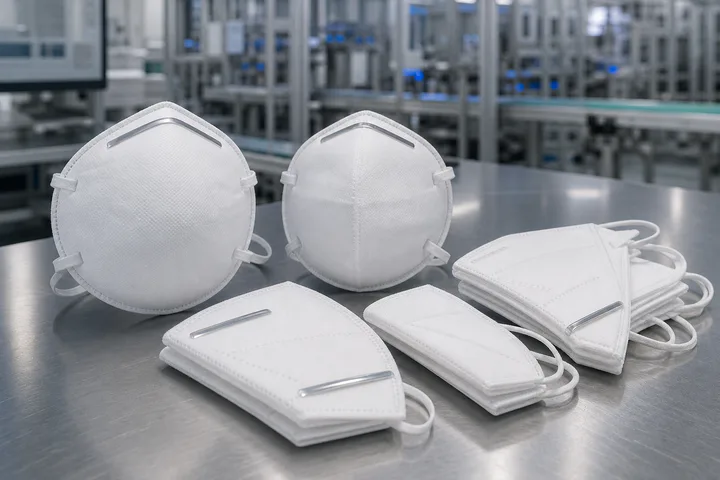
A practical guide for B2B buyers comparing N95 and KN95 respirators. Understand the core differences in certification standards (NIOSH vs GB), filtration efficiency, testing protocols, and real-world procurement considerations—including documentation, lead times, and quality risk—to make informed sourcing decisions.
BUYER GUIDE
- N95 and KN95 respirators both filter ≥95% of airborne particles, but they are certified under different national standards (NIOSH in the US, GB2626 in China).
- The biggest procurement difference is not filtration but documentation, regulatory acceptance, and supply chain reliability.
- KN95s often have shorter lead times and lower unit costs, but require careful supplier vetting—counterfeit products are common.
- For US government or OSHA-regulated contracts, N95 (NIOSH-approved) is typically mandatory. For commercial or non-US markets, KN95 is widely accepted.
- Always request a valid certificate (e.g., NIOSH approval number, GB2626 test report) and a sample for fit-check before bulk order.
Why This Comparison Matters for B2B Sourcing
If you're sourcing respirators for a hospital system, a manufacturing plant, a government tender, or a distribution network, the n95 vs kn95 decision is not just about which mask "works better." It's about which standard your end-user's regulations require, which certification documentation you can provide, and which supply chain can deliver consistently at your required volume.
Both respirators are designed to filter at least 95% of non-oil-based airborne particles (0.3 microns in diameter). But they are tested and certified under different systems, and that difference has real consequences for procurement compliance, cost, and lead time.
What Is an N95 Respirator?
N95 is a US standard defined by the National Institute for Occupational Safety and Health (NIOSH) under 42 CFR Part 84. To bear the N95 mark, a respirator must pass a rigorous testing protocol:
- Filtration efficiency: ≥95% of 0.3-micron NaCl particles at a flow rate of 85 L/min.
- Test method: Uses a TSI 8130 automated filter tester. The test is conducted on a batch of 20 units.
- Quality assurance: NIOSH conducts regular audits of the manufacturing facility. The approval is specific to the model and manufacturer.
- Fit testing: N95 certification does not mandate a fit test for the general public, but for workplace use (OSHA), a fit test is required.
Each NIOSH-approved N95 model has a unique approval number (e.g., TC-84A-XXXX). This number is traceable on the NIOSH Certified Equipment List (CEL).
What Is a KN95 Respirator?
KN95 is the Chinese standard, governed by GB2626-2019 (formerly GB2626-2006). It is the equivalent of N95 in terms of minimum filtration efficiency, but the testing protocol differs:
- Filtration efficiency: ≥95% of 0.3-micron NaCl particles at a flow rate of 85 L/min.
- Test method: Uses a similar NaCl aerosol test, but the test conditions (e.g., temperature, humidity, pre-conditioning) are not identical to NIOSH.
- Quality assurance: GB2626 certification is issued by Chinese authorities (e.g., the Standardization Administration of China). The manufacturer must have a valid production license and pass a factory audit.
- Fit testing: GB2626 includes a requirement for total inward leakage (TIL) testing, which is a measure of fit on a human face. This is a difference from N95, which does not require TIL for certification.
Authentic KN95 respirators carry a manufacturer name, model number, and the standard reference "GB2626-2019" printed on the mask or packaging.
N95 vs KN95: The Core Differences in Standards
Let's break down the n95 vs kn95 difference in a side-by-side comparison table. This is the table you should bookmark for your procurement team.
| Parameter | N95 (NIOSH) | KN95 (GB2626-2019) |
|---|---|---|
| Governing body | NIOSH (US) | Standardization Administration of China |
| Filtration efficiency | ≥95% @ 0.3 µm NaCl | ≥95% @ 0.3 µm NaCl |
| Test flow rate | 85 L/min | 85 L/min |
| Pre-conditioning | Yes (temperature, humidity, load) | Yes (but different protocols) |
| Total inward leakage (TIL) test | Not required for certification | Required (≤8% for 50th percentile face) |
| Fit test requirement (workplace) | OSHA requires fit test | GB/T 18664 recommends fit test |
| Certification mark | NIOSH logo + approval number | GB2626-2019 + manufacturer code |
| Regulatory acceptance (US) | OSHA, FDA, CDC accepted | Limited (EUA expired in 2021) |
| Regulatory acceptance (EU) | CE mark required (FFP2) | CE mark required (FFP2) |
| Typical unit cost (B2B bulk) | $0.50–$1.50 | $0.20–$0.80 |
| Lead time (bulk order) | 4–8 weeks (US mfg) or 6–12 weeks (import) | 2–6 weeks (direct from China) |
Filtration: Are They Actually the Same?
In laboratory conditions, both N95 and KN95 respirators can achieve ≥95% filtration efficiency. Independent studies (e.g., CDC NIOSH studies from 2020–2021) have shown that many KN95 models from reputable manufacturers perform at or above 95% efficiency.
However, the key difference is consistency and quality control. NIOSH certification includes unannounced factory audits and ongoing testing of production batches. GB2626 certification also requires factory audits, but enforcement and quality vary significantly across manufacturers—especially for smaller or less reputable producers.
For a B2B buyer, the practical implication is: do not assume all KN95s are equal. You must verify each supplier's test reports and production history.
Procurement Differences: What to Watch For
When you're sourcing either type, the n95 vs kn95 difference in procurement is not about filtration—it's about documentation, regulatory compliance, and risk.
1. Regulatory Acceptance by Market
- US market: For OSHA-regulated workplaces (healthcare, construction, manufacturing), NIOSH-approved N95 is the only acceptable class. KN95s were temporarily allowed under an FDA Emergency Use Authorization (EUA) during the pandemic, but that EUA expired in 2021. If your buyer is a US hospital or government agency, they will require N95.
- EU market: Both N95 and KN95 are not automatically accepted. The EU requires CE marking under EN 149 (FFP2 or FFP3). If you are exporting to Europe, you need a CE-certified product, regardless of whether it is labeled N95 or KN95.
- Asia, Middle East, Africa: KN95 is widely accepted, especially in China, Southeast Asia, and parts of Africa. Many buyers in these regions specify KN95 by name.
- Latin America: Acceptance varies. Some countries accept N95, others accept KN95, and many require local certification. Always confirm with the importer.
2. Documentation You Must Request
For any bulk order, ask for these documents from your supplier:
- For N95: NIOSH approval certificate (with TC number), batch test report, and a letter of authorization from the manufacturer (if you are a distributor).
- For KN95: GB2626-2019 test report from a CNAS-accredited lab, factory production license, and a certificate of conformity. Also request a sample for independent testing.
- For both: Certificate of analysis (COA) for each batch, packing list, and commercial invoice.
3. Quality Risk: Counterfeits and Substandard Products
During the pandemic, the market was flooded with counterfeit KN95s. Many masks labeled "KN95" had filtration efficiency below 50%. Even today, it is not uncommon to find KN95s that do not meet the claimed standard.
N95 counterfeits also exist, but they are less common because NIOSH maintains a public list of approved models and manufacturers. You can verify any N95 model instantly on the NIOSH CEL website.
4. Lead Time and Supply Chain
- N95: If you source from a US-based manufacturer (e.g., 3M, Honeywell, Moldex), lead times are typically 4–8 weeks for large orders. Importing N95 from China requires the supplier to have NIOSH approval, which is a longer process.
- KN95: Lead times from Chinese factories are generally 2–6 weeks. The supply chain is more flexible, with many manufacturers offering MOQs as low as 10,000 pieces.
5. Cost Comparison
KN95s are generally 40–60% cheaper than N95s at the same volume. However, the cost differential narrows when you factor in the cost of independent testing, documentation, and potential rejection if the product does not meet the buyer's requirements.
Which One Should You Source?
There is no universal answer. The decision depends on your buyer's market and end-use:
- Source N95 if: Your end-user is in the US healthcare system, a US government contractor, or any OSHA-regulated workplace. Also choose N95 if the buyer explicitly requires NIOSH approval.
- Source KN95 if: Your end-user is in China, Southeast Asia, the Middle East, or Africa, and the buyer accepts KN95. Also consider KN95 for non-regulated commercial use (e.g., general industry, construction in non-US markets) where cost is a priority.
- Source both if: You are a distributor serving multiple markets and want to offer a range of price points.
Frequently Asked Questions (B2B Procurement)
Can KN95 be used as a substitute for N95 in the US?
Not for OSHA-regulated workplaces. The FDA EUA that allowed KN95s expired in 2021. For general public use (non-workplace), there is no regulation, but most US buyers prefer N95 for liability reasons.
How do I verify a KN95 supplier's quality?
Request a GB2626-2019 test report from a CNAS-accredited lab. Also ask for a sample and have it tested independently (e.g., by a third-party lab like SGS or Bureau Veritas). Check the manufacturer's production license and factory audit history.
What is the MOQ for N95 vs KN95?
N95 MOQs from major US manufacturers are typically 10,000–50,000 pieces. KN95 MOQs from Chinese factories can be as low as 5,000–10,000 pieces, depending on the model.
Do I need a fit test for bulk orders?
If you are supplying to a workplace, the end-user is responsible for fit testing. As a supplier, you should provide a range of sizes (if available) and a fit-test guide. Some KN95s are available in multiple sizes; N95s often have a one-size-fits-most design.
Final Advice for B2B Buyers
The n95 vs kn95 decision is not a technical debate—it is a procurement strategy choice. Start with your buyer's regulatory requirements. Then evaluate cost, lead time, and supplier reliability. Always verify documentation and test a sample before committing to a large order.
If you are new to sourcing respirators, we recommend starting with a small pilot order (e.g., 10,000–20,000 pieces) from a supplier that can provide both N95 and KN95 options. This gives you flexibility to test the market and adjust your sourcing strategy.
For a detailed quote or to discuss your specific requirements, contact our team. We supply both NIOSH-approved N95 and GB2626-certified KN95 respirators from our ISO 9001-certified facility.