
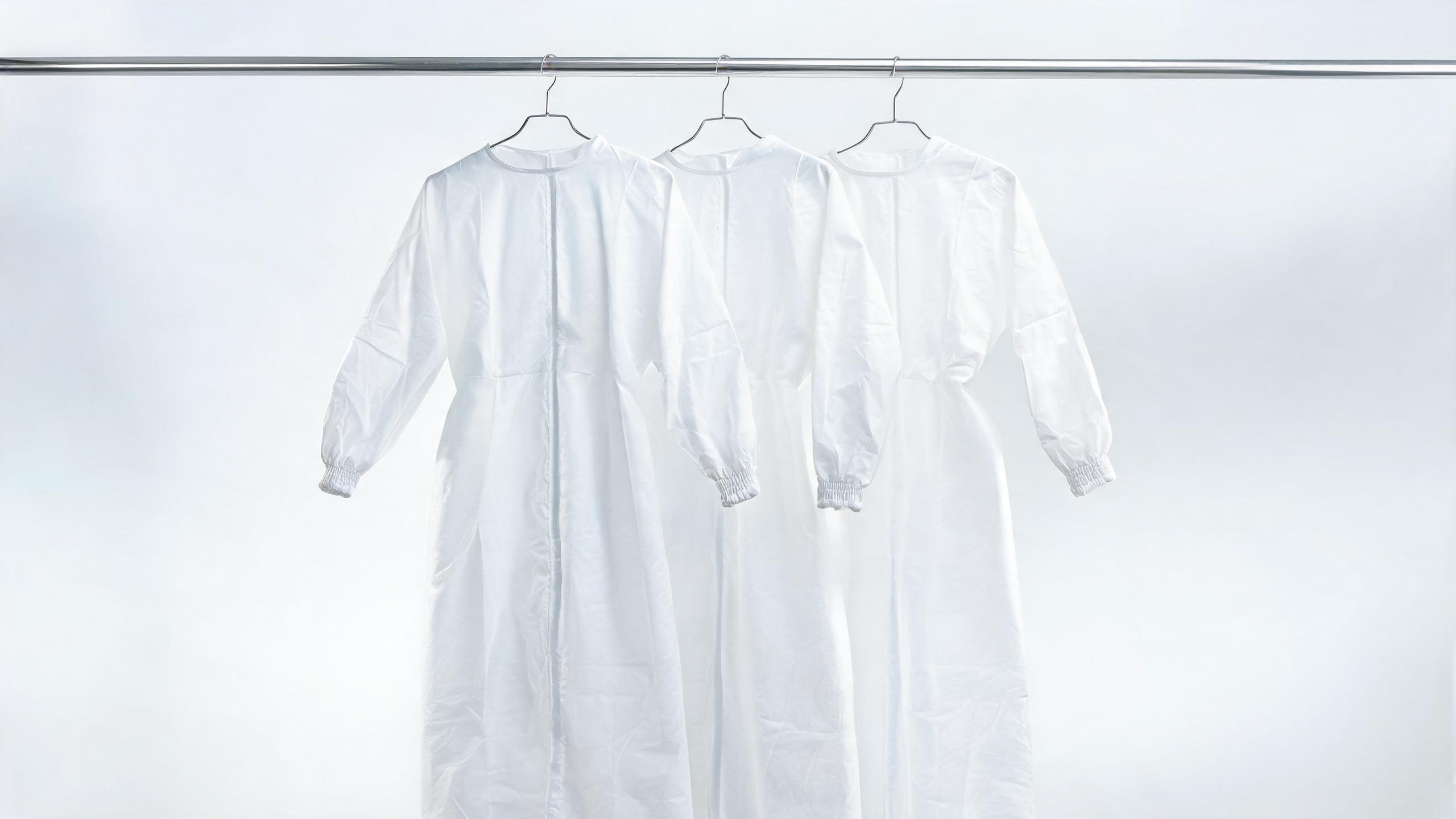
A comprehensive guide for healthcare procurement professionals on selecting medical protective gowns. Covers the three main material types—SMS nonwoven, PE, and PP—their grades, the critical EN ISO 13795 standard for surgical gowns, and a practical supplier selection checklist to ensure quality, compliance, and cost-efficiency.
PROCUREMENT GUIDE
- Three main gown material types—SMS, PE, and PP—serve different risk levels and cost points. SMS is the standard for isolation and surgical use; PE is for high-fluid barrier at low cost; PP is the most economical for low-risk tasks.
- EN ISO 13795 is the definitive standard for surgical gowns in Europe. It defines performance levels (AAMI Levels 1–4) and critical test methods for liquid barrier, strength, and microbial penetration.
- Nonwoven gown grades (e.g., 25 gsm vs 45 gsm SMS, or 30 gsm vs 50 gsm PP) directly impact barrier performance, comfort, and cost. Know the grade you need for each application.
- Supplier selection should be based on verifiable compliance documentation, consistent quality control, and transparent communication—not just price.
- Bulk purchasing of medical protective gowns requires careful evaluation of MOQ, lead time, packaging, and certification validity.
Introduction: Why Material Choice Matters in Medical Gowns
For healthcare procurement professionals, the choice of a medical protective gown is not a simple "one size fits all" decision. The gown is a critical piece of personal protective equipment (PPE) that directly impacts staff safety, patient outcomes, and operational costs. A wrong material choice can lead to fluid strike-through, increased infection risk, staff discomfort, or wasted budget.
This guide cuts through the marketing noise. We will examine the three dominant nonwoven materials—SMS (Spunbond-Meltblown-Spunbond), PE (Polyethylene), and PP (Polypropylene)—their grades, the regulatory framework of EN ISO 13795, and a practical framework for selecting a reliable disposable medical gown supplier.
Section 1: The Three Pillars of Nonwoven Gown Materials
1.1 SMS Nonwoven Isolation Gown: The Workhorse of Healthcare
SMS nonwoven isolation gown fabric is a three-layer composite: two outer layers of spunbond polypropylene for strength and durability, and a middle meltblown layer for filtration and fluid barrier. This structure gives SMS a balance of protection, breathability, and comfort that makes it the most widely used material for both isolation gowns and surgical gowns.
Key properties of SMS:
- Fluid resistance: The meltblown layer provides a good barrier against blood, body fluids, and water. Performance varies by weight (gsm) and construction.
- Breathability: Better than PE or laminated fabrics, reducing heat stress for staff during long shifts.
- Strength: High tensile and tear strength, especially in higher gsm grades.
- Lint-free: Low particle shedding, important for clean environments.
- Cost: Mid-range. More expensive than PP, less than high-end laminated films.
Typical grades of SMS for medical gowns:
| Grade (gsm) | Typical Barrier Level | Common Use | Relative Cost |
|---|---|---|---|
| 25–30 gsm | Low (AAMI Level 1) | Basic isolation, low-risk patient care | Low |
| 35–40 gsm | Medium (AAMI Level 2) | Standard isolation, blood draw, minor procedures | Medium |
| 45–50 gsm | High (AAMI Level 3) | Surgical gowns, moderate-risk procedures | High |
| 55+ gsm | Very High (AAMI Level 4) | High-risk surgical, trauma, infectious disease | Highest |
When to choose SMS: For any application where fluid exposure is possible but not heavy, and where staff comfort is a priority. It is the default choice for most hospital isolation gowns and surgical gowns.
1.2 PE (Polyethylene) Gown: Maximum Barrier at Low Cost
PE medical protective gowns are made from a thin polyethylene film. They are typically used as a coverall or over-gown, worn over a cotton or polyester uniform. The material is impermeable to liquids, providing the highest fluid barrier among the three types.
Key properties of PE:
- Fluid resistance: Excellent. PE is non-porous and completely blocks water, blood, and chemicals.
- Breathability: Very poor. PE traps heat and moisture, causing discomfort and heat stress in extended use.
- Strength: Low. PE tears easily, especially at stress points like seams.
- Cost: Very low. The cheapest option for bulk procurement.
Typical grades of PE:
- Standard PE (30–50 microns): Basic fluid barrier, used for short-term tasks like cleaning, isolation, or low-risk patient contact.
- Reinforced PE (with PP or nonwoven backing): Adds some strength but still lacks breathability.
- Anti-static PE: For use in environments with flammable gases or sensitive electronics.
When to choose PE: For short-duration, high-fluid-exposure tasks where cost is the primary driver. Examples: cleaning, waste management, handling infectious materials, or as an outer layer over a cotton uniform. Not recommended for long surgical procedures.
1.3 PP (Polypropylene) Nonwoven Gown: The Economical Option
PP nonwoven gowns are made from spunbond polypropylene only—no meltblown layer. This makes them the lightest, most breathable, and cheapest option among the three. However, they offer minimal fluid barrier.
Key properties of PP:
- Fluid resistance: Low. PP is hydrophobic but not a barrier. It will wet through quickly under liquid exposure.
- Breathability: Excellent. Very comfortable for long wear.
- Strength: Moderate. Good for low-stress use.
- Cost: Lowest. The most economical choice for bulk procurement.
Typical grades of PP:
| Grade (gsm) | Barrier Level | Common Use | Relative Cost |
|---|---|---|---|
| 15–20 gsm | None | Visitor gowns, low-risk patient contact | Lowest |
| 25–30 gsm | Minimal | Isolation gowns for dry tasks | Low |
| 35+ gsm | Low | Basic isolation, but still not fluid-resistant | Low-Medium |
When to choose PP: For low-risk, dry environments where cost is the primary concern. Examples: visitor gowns, administrative areas, or low-contact patient care. Not suitable for any procedure with fluid exposure.
Section 2: EN ISO 13795 Compliance – The Standard for Surgical Gowns
For healthcare procurement, especially in Europe and many other regulated markets, EN ISO 13795 is the definitive standard for surgical gowns. It replaced the earlier EN 13795 standard and harmonizes with ISO 13795. Understanding this standard is essential for selecting a compliant EN ISO 13795 surgical gown.
What EN ISO 13795 Covers
EN ISO 13795 specifies requirements for surgical gowns, including:
- Liquid barrier performance: Resistance to water and blood penetration.
- Microbial penetration: Resistance to dry and wet microbial penetration.
- Physical properties: Tensile strength, tear resistance, and linting.
- Seam strength: The ability of seams to withstand stress.
- Packaging and labeling: Requirements for sterile packaging and product information.
Performance Levels (AAMI Levels 1–4)
The standard defines four performance levels, based on the gown's intended use and risk of fluid exposure. These levels align with the AAMI (Association for the Advancement of Medical Instrumentation) classification system:
| Level | Description | Typical Use | Key Test |
|---|---|---|---|
| Level 1 | Minimal fluid barrier | Basic isolation, low-risk patient care | Water penetration test (AATCC 42) |
| Level 2 | Low fluid barrier | Blood draw, suturing, minor procedures | Water penetration test (AATCC 42) |
| Level 3 | Moderate fluid barrier | Intravenous therapy, arterial blood draw, moderate-risk surgery | Water penetration test (AATCC 42) + synthetic blood test (ASTM F1670) |
| Level 4 | High fluid barrier | High-risk surgery, trauma, infectious disease, heavy fluid exposure | Synthetic blood test (ASTM F1670) + viral penetration test (ASTM F1671) |
How to Verify EN ISO 13795 Compliance
When evaluating a supplier's claim of compliance, ask for:
- Test report from an accredited laboratory: The report should show the specific test methods and results for each required parameter.
- CE marking documentation: For surgical gowns sold in the EU, the manufacturer must have a CE certificate (issued by a notified body) demonstrating compliance with the Medical Device Regulation (MDR) or its predecessor (MDD).
- Declaration of Conformity (DoC): A formal document from the manufacturer stating that the product meets the requirements of EN ISO 13795.
- Product labeling: The gown packaging should clearly state the standard reference (EN ISO 13795) and the performance level (e.g., Level 1, Level 2, etc.).
"EN ISO 13795 compliance is not a suggestion—it is a regulatory requirement for surgical gowns in the EU. If a supplier cannot provide a test report from an accredited lab, the claim is not valid."
Section 3: Isolation Gown Material Grades – What to Look For
Beyond the material type, the isolation gown material grades (gsm, construction, and finish) are the most important factors in determining performance and cost. Here is a breakdown of what to look for:
Key Parameters for Evaluating Gown Grades
- Weight (gsm): Higher gsm generally means better barrier and strength, but also higher cost and less breathability. For SMS, 35–40 gsm is the most common for standard isolation gowns.
- Fabric construction: SMS vs. spunbond vs. meltblown vs. laminated. Each has different properties.
- Finish: Hydrophilic (water-absorbing) vs. hydrophobic (water-repelling). For fluid barrier, hydrophobic is preferred.
- Seam type: Serged seams (common) vs. bound seams (stronger, more expensive). For high-risk use, bound seams are preferred.
- Antistatic treatment: Important for operating rooms and environments with flammable gases.
- Color and sizing: Standard colors (blue, green, yellow) and sizes (S to 3XL) are most common.
Comparison Table: SMS vs. PE vs. PP at a Glance
| Property | SMS Nonwoven | PE (Polyethylene) | PP (Polypropylene) |
|---|---|---|---|
| Fluid Barrier | Good (Level 1–4) | Excellent (Level 4) | Poor (Level 1) |
| Breathability | Good | Very Poor | Excellent |
| Strength | High | Low | Moderate |
| Comfort | Good | Poor | Excellent |
| Cost (per unit) | Medium | Very Low | Low |
| Best Use | Isolation & surgical | High-fluid, short-term | Low-risk, dry tasks |
Section 4: Supplier Selection for Healthcare Procurement
Choosing the right disposable medical gown supplier is as important as choosing the right material. A poor supplier can lead to inconsistent quality, delayed deliveries, compliance issues, and reputational damage. Here is a practical checklist for evaluating suppliers:
Supplier Evaluation Checklist
- Certification and Compliance:
- Does the supplier have ISO 13485 (medical device quality management) certification?
- Can they provide EN ISO 13795 test reports from an accredited lab?
- Do they have CE marking for surgical gowns (if required for your market)?
- Are their products registered with the FDA (for the US market) or equivalent?
- Manufacturing Capability:
- What is the production capacity (units per month)?
- Do they have in-house testing facilities?
- What is the lead time for bulk orders?
- Can they handle custom orders (e.g., specific color, size, or packaging)?
- Quality Control:
- What are their QC procedures? Do they perform in-process and final inspection?
- Do they have a documented quality manual?
- What is their defect rate (claimed or verified)?
- Do they provide a Certificate of Analysis (CoA) with each shipment?
- Commercial Terms:
- What is the MOQ (minimum order quantity)?
- What are the payment terms (e.g., T/T, L/C)?
- What is the typical lead time for production?
- What is the packaging standard (e.g., 50 pcs/box, 10 boxes/carton)?
- What is the shipping method (FOB, CIF, EXW)?
- Communication and Transparency:
- Do they respond promptly to inquiries?
- Are they willing to provide samples for testing?
- Do they provide clear documentation (technical data sheets, MSDS, certificates)?
- Do they have a local agent or distributor in your region?
Common Mistakes in Supplier Selection
- Focusing only on price: The cheapest option often comes with hidden costs—poor quality, delayed shipping, or non-compliance.
- Not verifying certifications: A supplier may claim EN ISO 13795 compliance but not have the test reports. Always ask for proof.
- Ignoring MOQ and lead time: A low MOQ may seem attractive, but it can indicate a lack of production capacity. Conversely, a high MOQ may be difficult to manage.
- Not testing samples: Always request samples and test them under your own conditions before placing a bulk order.
- Overlooking packaging: Poor packaging can lead to damage during shipping or contamination of sterile gowns.
Section 5: Bulk Procurement of Medical Protective Gowns – Practical Considerations
When purchasing medical protective gown bulk quantities, the following factors become critical:
MOQ and Pricing
MOQ for SMS gowns typically ranges from 10,000 to 50,000 pieces per size. For PE gowns, MOQ can be as low as 5,000 pieces. For PP gowns, MOQ is often 10,000–20,000 pieces. Pricing per unit decreases significantly with volume. Expect to pay 10–30% less per unit for orders of 100,000+ pieces compared to 10,000 pieces.
Lead Time
Standard lead time for bulk orders is 30–45 days from order confirmation. Rush orders (15–20 days) are possible but at a premium. Always factor in shipping time (2–6 weeks depending on destination and mode).
Packaging and Labeling
Standard packaging for bulk orders is 50 pieces per poly bag, 10 bags per carton (500 pieces per carton). For sterile gowns, each gown is individually packaged in a sterile pouch. Labels must include: product name, size, material, lot number, expiration date, and certification references.
Shipping and Logistics
Bulk orders are typically shipped via sea freight (FOB or CIF). Air freight is faster but significantly more expensive. Ensure the supplier provides proper packing for sea transport (e.g., palletizing, moisture-proof wrapping).
FAQ: Common Questions from Healthcare Procurement Professionals
Q1: What is the difference between an isolation gown and a surgical gown?
An isolation gown is used for general patient care and low-risk procedures. A surgical gown is used for invasive procedures and must meet stricter fluid barrier and microbial penetration standards (EN ISO 13795). Surgical gowns are typically sterile and individually packaged.
Q2: Can I use a PP gown for fluid exposure?
No. PP gowns offer minimal fluid barrier. They are suitable only for dry, low-risk tasks. For any fluid exposure, use SMS or PE gowns.
Q3: How do I verify EN ISO 13795 compliance?
Ask the supplier for a test report from an accredited laboratory (e.g., SGS, TÜV, Intertek). The report should show the specific test methods and results for the required parameters. Also, check for CE marking and a Declaration of Conformity.
Q4: What is the typical MOQ for bulk orders?
MOQ varies by supplier and material. For SMS gowns, expect 10,000–50,000 pieces per size. For PE and PP, 5,000–20,000 pieces. Always confirm with the supplier.
Q5: How long does a bulk order take?
Standard lead time is 30–45 days from order confirmation. Rush orders (15–20 days) are possible at a premium. Shipping adds 2–6 weeks.
Q6: What should I look for in a supplier's quality control?
Look for ISO 13485 certification, in-process and final inspection, documented QC procedures, and the ability to provide a Certificate of Analysis (CoA) with each shipment.
Conclusion: Making the Right Choice
Selecting the right medical protective gown is a multi-faceted decision that balances material properties, regulatory compliance, and commercial terms. By understanding the differences between SMS, PE, and PP nonwoven materials, the requirements of EN ISO 13795, and the criteria for evaluating a disposable medical gown supplier, you can make informed procurement decisions that protect your staff, patients, and budget.
For a specific product inquiry, including detailed specifications, test reports, and pricing for bulk orders, please contact us. We can provide samples and documentation to support your evaluation process.