
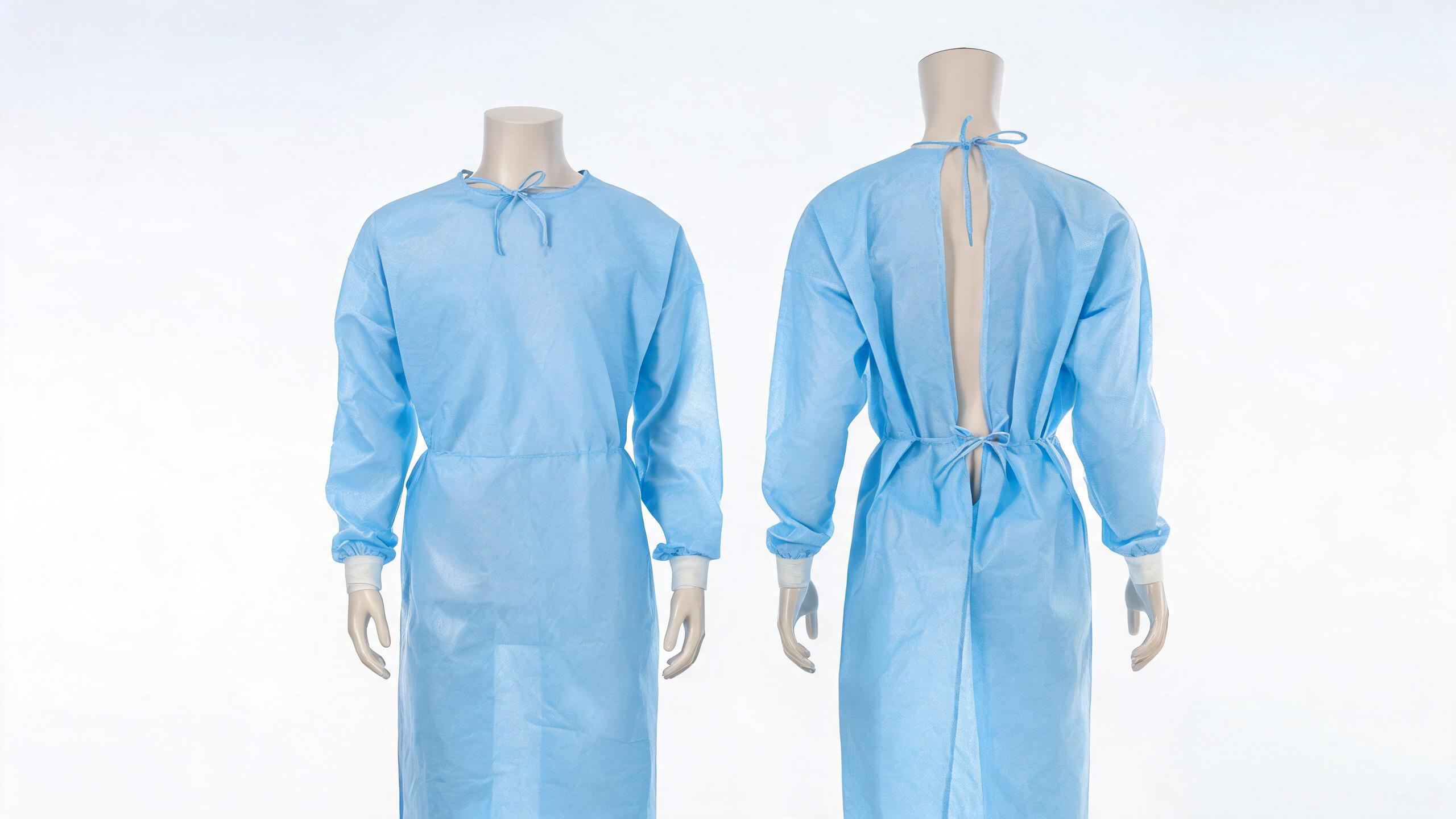
A practical guide for healthcare procurement professionals on sourcing hospital disposable gowns. Covers AAMI protection levels (Level 1–4), SMS material selection criteria, and bulk procurement strategies to ensure compliance, cost control, and supply chain reliability.
BUYER GUIDE
• AAMI Level 1–4 defines the barrier protection required — match the gown to the procedure, not the price.
• SMS (Spunbond-Meltblown-Spunbond) is the dominant nonwoven fabric for disposable surgical gowns; gram weight and layer structure directly affect protection and breathability.
• Bulk procurement should factor in MOQ, lead time, packaging format, and certification documentation — not just unit price.
• Always request a physical sample and a certificate of compliance before placing a volume order.
Why AAMI Levels Matter When Sourcing Hospital Disposable Gowns
Every healthcare buyer sourcing hospital disposable gowns needs to start with one question: What level of barrier protection does the procedure require?
The American National Standards Institute (ANSI) and the Association for the Advancement of Medical Instrumentation (AAMI) jointly define four levels of protection for medical disposable gowns. These levels are based on standardized tests for liquid penetration, tear resistance, and seam strength. Ignoring them means risking either under-protection (liability, infection) or over-specification (wasted budget).
| AAMI Level | Typical Use | Key Performance Requirement | Common Material |
|---|---|---|---|
| Level 1 | Basic care, standard isolation, visitor gowns | Minimal fluid resistance; no barrier test required | Lightweight SMS, PP nonwoven |
| Level 2 | Blood draw, suturing, ICU rounds | Pass AATCC 42 (impact penetration) ≤ 1.0 g | SMS 25–30 gsm, reinforced PP |
| Level 3 | IV insertion, ER trauma, minor surgery | Pass AATCC 42 ≤ 1.0 g and AATCC 127 (hydrostatic pressure) ≥ 45 cm | SMS 35–45 gsm, or SMS with film laminate |
| Level 4 | Major surgery, high-risk infection control | Pass ASTM F1670 (viral penetration) and ASTM F1671 (bloodborne pathogen) | Reinforced SMS + impervious film, or laminated nonwoven |
For a typical hospital procurement manager, the most common order is Level 2 and Level 3 disposable surgical gowns. These cover the majority of clinical procedures. Level 1 is often reserved for non-patient-care areas, while Level 4 is a smaller-volume, higher-cost product for operating rooms and infectious disease units.
SMS Material Selection: What Every Buyer Should Know
When you see a spec sheet for a disposable gown, the material is almost always listed as "SMS." This stands for Spunbond-Meltblown-Spunbond, a three-layer nonwoven fabric. Here is what each layer does:
- Spunbond (outer and inner layers): Provides tensile strength, abrasion resistance, and a smooth surface. Typically made of polypropylene (PP).
- Meltblown (middle layer): Acts as the barrier. Microfibers create a dense web that blocks liquids and particles while still allowing air to pass through.
Buyers often ask: What gram weight (gsm) should I specify? The answer depends on the AAMI level required:
- 18–25 gsm SMS: Suitable for Level 1 gowns. Lightweight, low cost, but minimal barrier.
- 25–35 gsm SMS: Common for Level 2. Good balance of comfort and protection.
- 35–45 gsm SMS: Typical for Level 3. Heavier, with higher hydrostatic pressure resistance.
- 45+ gsm SMS with film lamination: Used for Level 4. The film adds an impervious barrier but reduces breathability.
One common mistake: assuming that a higher gsm always means a higher AAMI level. A 40 gsm SMS without a meltblown layer of sufficient density may still fail the AATCC 127 hydrostatic pressure test. Always ask for the test report, not just the material weight.
Bulk Procurement Strategies for PPE Gowns
Buying PPE gowns in volume is different from ordering a few boxes for a clinic. Here are the key factors that affect cost, delivery, and compliance.
1. MOQ (Minimum Order Quantity)
For standard hospital disposable gowns (Level 1 or 2, single color, standard SMS), MOQ from a factory is typically 10,000–50,000 pieces per size. For custom colors, printed logos, or special packaging, MOQ can go up to 100,000 pieces. If your volume is below that, you will likely pay a premium or need to work with a distributor rather than a manufacturer.
2. Packaging Format
Gowns are usually packed in one of three ways:
- Bulk pack: 50–100 gowns per poly bag, no individual wrapping. Lowest cost per unit. Suitable for non-sterile, general use.
- Individually folded: Each gown folded and packed in a bag, often 50 per case. Common for sterile gowns or hospital stock.
- Individually wrapped & sterilized: Each gown sealed in a peel-pouch, then gamma or EO sterilized. Used for surgical gowns. Highest cost, but required for operating rooms.
Ask your supplier: What is the cost difference between bulk pack and individual wrap? It can be 15–30% more per unit.
3. Lead Time
For a standard SMS gown order, production lead time is typically 30–45 days from confirmation of sample and deposit. During peak demand (flu season, pandemic surges), lead times can stretch to 60–90 days. If you need faster delivery, ask about "stock" or "ready-to-ship" options — but be prepared to pay a premium.
4. Certification Documentation
Before placing a bulk order, request the following documents from your supplier:
- Test report from an accredited third-party lab (e.g., SGS, Intertek, TÜV) confirming the AAMI level.
- Certificate of compliance stating that the gowns meet the relevant standard (e.g., ASTM F3352 for Level 1–3, or ASTM F2407 for surgical gowns).
- Material safety data sheet (MSDS) for the nonwoven fabric.
- Factory audit report (ISO 13485 or similar) if sourcing directly from a manufacturer.
Do not rely on a supplier's claim alone. Ask for the lab report number and verify it with the testing body.
Common Mistakes When Buying Disposable Surgical Gowns
Based on feedback from procurement teams across hospitals and group purchasing organizations (GPOs), here are the most frequent errors:
- Buying Level 4 for all procedures. Level 4 gowns are expensive and less breathable. Use them only for high-risk procedures. Level 2 or 3 is sufficient for most routine care.
- Ignoring seam strength. A gown can pass the fabric barrier test but fail at the seams. Ask for seam strength data (ASTM D1683 or similar).
- Not checking sizing. A "one-size-fits-all" gown often fits poorly, leading to exposure and waste. Order at least three sizes (S/M, L/XL, and XXL) for a hospital.
- Assuming all SMS is the same. SMS from different mills can vary in barrier performance, hand feel, and color consistency. Always request a production sample before the full order.
How to Evaluate a Supplier for PPE Gowns
When you shortlist suppliers for medical disposable gowns, use this checklist during your evaluation:
- Ask for the specific AAMI test report — not a generic certificate, but the actual test report with the lab's name, date, and results.
- Request a sample pack covering all sizes and the exact material grade you intend to order.
- Confirm the MOQ, lead time, and payment terms in writing.
- Check the factory's certification — ISO 13485 (medical devices) is a minimum. If exporting to the EU, CE marking (under MDR) is required. For the US market, FDA registration or 510(k) clearance may be needed.
- Ask about packaging and labeling — does the supplier offer private labeling? Can they print your GPO contract number or hospital logo on the box?
Frequently Asked Questions
Q: What is the difference between a disposable isolation gown and a disposable surgical gown?
An isolation gown is typically used for patient care in non-surgical settings (e.g., ICU, isolation wards). It usually meets AAMI Level 1 or 2. A surgical gown is used in the operating room and must meet at least AAMI Level 3, with Level 4 for high-risk procedures. Surgical gowns also have specific requirements for cuff design, back closure, and seam integrity.
Q: Can I use SMS gowns for Level 4 protection?
Standard SMS alone cannot pass the viral penetration test (ASTM F1670) required for Level 4. For Level 4, the gown must have an impervious film layer (e.g., polyethylene or polyurethane) laminated to the SMS. This is sometimes called "SMS + film" or "reinforced SMS."
Q: What is the typical shelf life of a disposable gown?
For non-sterile gowns, shelf life is usually 3–5 years from the date of manufacture, provided the packaging remains intact and the gown is stored in a cool, dry place. Sterile gowns have a shorter shelf life — typically 2–3 years — depending on the sterilization method and packaging integrity.
Q: How do I verify that a supplier's gown is truly AAMI Level 3?
Ask for the AATCC 42 (impact penetration) and AATCC 127 (hydrostatic pressure) test reports. The results must show ≤ 1.0 g for impact penetration and ≥ 45 cm for hydrostatic pressure. If the supplier cannot provide these, the gown is not Level 3.
Next Steps for Healthcare Buyers
Sourcing hospital disposable gowns is a balance of protection, cost, and supply reliability. Start by defining the AAMI level you need for each clinical area. Then match the material (SMS gram weight and layer structure) to that level. Finally, work with a supplier who can provide certified test reports, consistent quality, and transparent lead times.
If you are currently evaluating suppliers for disposable surgical gowns or other PPE gowns, we recommend requesting samples from at least three manufacturers and comparing their test reports side by side. The cheapest option is rarely the safest — and in healthcare, safety is not negotiable.
For detailed specifications, MOQ information, or to request a sample pack, please contact our team.