
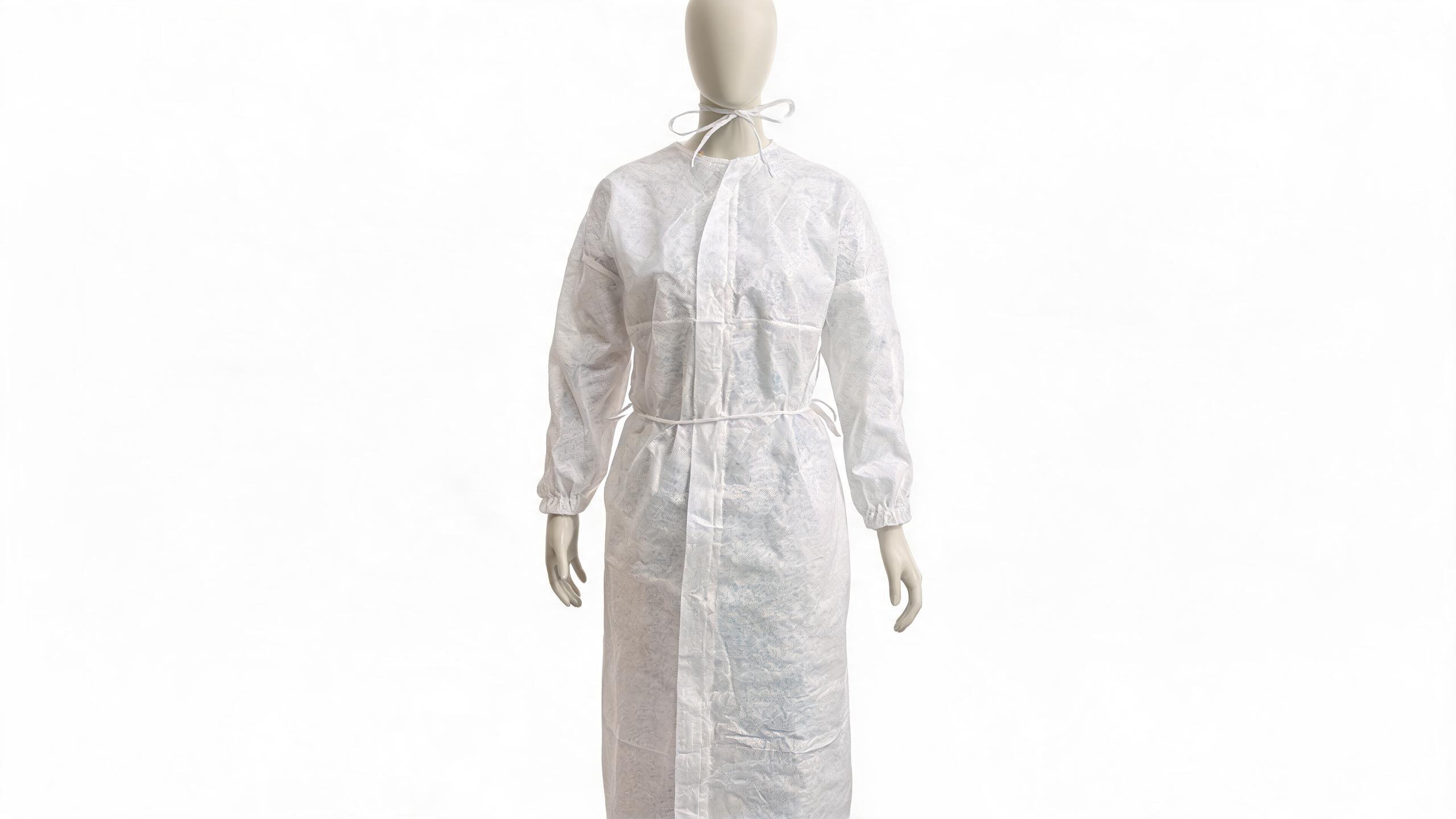
一份关于医用防护服中SMS非织造布的深入指南,涵盖三层结构、GSM标准、阻隔性能测试(EN ISO 13795、AAMI PB70)、接缝构造以及医疗保健采购的材料选择。
Material Science for Medical Procurement
What Is SMS Nonwoven Fabric and Why It Dominates Medical Protective Gown Manufacturing
SMS nonwoven fabric - short for Spunbond-Meltblown-Spunbond - is a tri-layer composite material that forms the structural backbone of modern medical protective gowns. Each layer serves a distinct purpose: the outer spunbond layers provide tensile strength and durability, while the inner meltblown layer acts as the critical liquid and microbial barrier. This sandwich structure delivers a combination of breathability, fluid resistance, and mechanical integrity that no single-layer material can match, which is why it has become the global standard for surgical and isolation gowns regulated under EN ISO 13795 and AAMI PB70.
Key Takeaway: SMS fabric quality is determined by three factors: total GSM (grams per square meter), the meltblown layer's proportion, and the bonding technology used. For medical gowns, 40-50 GSM SMS with a properly calibrated meltblown core meets EN ISO 13795 Type B requirements. Seam construction (sewn vs. ultrasonically sealed) is equally critical to overall barrier performance.
The Three-Layer Structure of SMS Fabric Explained
Spunbond Layers (Outer and Inner)
Spunbond nonwoven fabric is manufactured by extruding molten polypropylene through a spinneret with hundreds of fine holes, producing continuous filaments that are laid down on a moving conveyor belt and then thermally bonded. The resulting fabric has the following characteristics:
- Tensile strength: Typically 30-60 N/5cm in machine direction, providing the structural frame of the gown
- Weight: Usually 15-25 GSM per spunbond layer
- Fiber diameter: 15-35 microns, creating a relatively open structure that allows moisture vapor transmission
- Functions: Mechanical protection, printability, and a smooth surface for patient and wearer comfort
Meltblown Layer (Center)
The meltblown layer is the heart of SMS fabric's barrier performance. It is produced using a specialized process where molten polymer is blown by high-velocity hot air onto a collector screen, producing microfibers with diameters of 1-5 microns - significantly finer than spunbond fibers. This dense, fine-fiber web provides:
- Liquid barrier: The tortuous path created by fine fibers blocks liquid penetration while allowing water vapor to pass through
- Bacterial filtration: Typically achieves BFE (Bacterial Filtration Efficiency) of ≥95% at proper GSM
- Weight: Usually 10-20 GSM, representing the most technically demanding and costly component
- Electrostatic charge: Some meltblown layers are electret-treated to enhance particle capture efficiency
GSM Standards: How Fabric Weight Determines Protection Level
GSM (grams per square meter) is the primary specification that determines a protective gown's performance tier. Higher GSM generally means better barrier protection but reduced breathability and higher cost. The medical industry uses several standard GSM ranges mapped to protection levels:
| SMS GSM Range | Typical Application | EN ISO 13795 Type | AAMI PB70 Level | Liquid Barrier |
|---|---|---|---|---|
| 30-35 GSM | Basic visitor gowns, non-critical care | Type 1 (low barrier) | Level 1 | Minimal fluid exposure |
| 35-40 GSM | Standard isolation gowns | Type 2 (moderate barrier) | Level 2 | Low fluid exposure |
| 40-50 GSM | Surgical gowns, high-risk isolation | Type B (high barrier) | Level 3-4 | Moderate to high fluid exposure |
| 50+ GSM | Enhanced surgical, pandemic response | Type B (high barrier) | Level 4 | Heavy fluid exposure, pathogen resistance |
For reference, Justsun's premium medical protective gown uses 50 GSM SMS nonwoven fabric with EN ISO 13795 Type B certification, sewn seams with protective tape, and an extended 145cm length for full-body coverage. The standard version uses SMS construction with reinforced front panel and sleeves, certified to EN ISO 13795.
SMS vs. Alternative Nonwoven Materials for Medical Gowns
While SMS is the dominant material for disposable medical gowns, procurement teams should understand the alternatives to make informed specification decisions:
| Material | Structure | Typical GSM | Fluid Resistance | Breathability | Cost |
|---|---|---|---|---|---|
| SMS | Spunbond-Meltblown-Spunbond | 35-50 | High | Good | Medium |
| SMMS | Spunbond-Meltblown-Meltblown-Spunbond | 40-60 | Very high | Good | Medium-high |
| SMMMS | Spunbond + 3x Meltblown + Spunbond | 45-70 | Excellent | Fair | High |
| Spunbond only (PP) | Single-layer polypropylene | 30-50 | Low | Excellent | Low |
| PE-coated | PP spunbond + polyethylene film | 40-60 | Excellent | Poor | Medium |
SMMS and SMMMS fabrics offer progressively higher barrier performance by adding multiple meltblown layers, but at increased cost and reduced breathability. PE-coated fabrics provide near-total liquid resistance but trap heat and moisture, making them suitable only for short-duration high-risk procedures. For most surgical and isolation applications, standard SMS at 40-50 GSM provides the optimal balance.
Barrier Performance Testing: What the Standards Actually Measure
EN ISO 13795 Test Requirements
EN ISO 13795 is the European standard for surgical gowns and drapes. It defines performance requirements across several test categories:
- Liquid penetration resistance (hydrostatic pressure): Measures the pressure at which liquid penetrates the fabric. Type B gowns must withstand ≥20 cmH₂O for critical zones
- Burst strength: Fabric must withstand ≥40 kPa without rupturing
- Tensile strength: Minimum 30 N in the machine direction for critical zones
- Linting: Maximum 4.0 log₁₀ lint count to minimize wound contamination risk
- Microbial cleanliness: Bioburden must not exceed 300 CFU per gown
AAMI PB70 Test Requirements
The AAMI PB70 standard (used in the US market) classifies gowns into four levels based on liquid barrier performance:
- Level 1: Impact penetration ≤4.5g (minimal fluid exposure risk)
- Level 2: Impact penetration ≤1.0g + hydrostatic pressure ≥20 cmH₂O (low fluid risk)
- Level 3: Impact penetration ≤1.0g + hydrostatic pressure ≥50 cmH₂O (moderate fluid risk)
- Level 4: Viral penetration resistance (passes ASTM F1671) for high-risk procedures
Seam Construction: The Weakest Link in Gown Barrier Integrity
Even with high-quality SMS fabric, a gown's overall barrier performance depends heavily on how the seams are constructed. Seam failure is one of the most common causes of protective gown compromise during clinical use.
Common Seam Types
- Sewn seams: The most basic construction, using thread to join panels. Without additional sealing, the needle holes create pathways for liquid penetration. Suitable only for low-risk applications (AAMI Level 1-2)
- Sewn seams with protective tape: A heat-sealed tape is applied over sewn seams to cover needle holes. This significantly improves barrier integrity and is required for EN ISO 13795 Type B gowns. Justsun's premium gown uses this construction
- Ultrasonic welding: Panels are joined using ultrasonic energy, creating a bonded seam without needle holes. Provides excellent barrier integrity and is preferred for high-risk applications
- Heat-sealed seams: Thermal bonding of thermoplastic materials, creating a continuous waterproof seam. Highest barrier performance but limited to compatible materials
Procurement Insight: When evaluating gown suppliers, always ask which seam construction is used in the critical zones (chest, abdomen, sleeves). A 50 GSM SMS gown with unprotected sewn seams will not provide the same real-world protection as a 40 GSM gown with ultrasonically sealed or taped seams.
Breathability and Comfort: The Often-Overlooked Performance Metric
Barrier protection is only half the equation. If a gown traps too much heat and moisture, healthcare workers will experience thermal stress, reduced concentration, and potential non-compliance with PPE protocols. The key metric for breathability is Moisture Vapor Transmission Rate (MVTR), measured in g/m²/24h:
- MVTR >1000 g/m²/24h: Excellent breathability, suitable for extended wear (4+ hours)
- MVTR 500-1000 g/m²/24h: Good breathability, suitable for standard surgical procedures
- MVTR 200-500 g/m²/24h: Moderate breathability, suitable for short-duration procedures
- MVTR <200 g/m²/24h: Poor breathability, suitable only for brief high-risk procedures
Standard SMS fabric at 40-50 GSM typically achieves MVTR of 600-1200 g/m²/24h, depending on the meltblown layer's density and electrostatic treatment. This is why SMS remains preferred over PE-coated alternatives for extended-use scenarios.
SMS Fabric Manufacturing Quality: What Differentiates Premium from Budget
Not all SMS fabric is created equal. The same nominal GSM specification can yield vastly different barrier performance depending on manufacturing quality:
- Meltblown uniformity: Variations in meltblown layer thickness create weak spots where liquid can penetrate. Premium manufacturers use inline basis weight scanners to ensure uniformity within ±5%
- Fiber diameter consistency: Finer, more consistent meltblown fibers (1-3 microns) create a more effective barrier than coarser, irregular fibers (5-10 microns)
- Bonding temperature control: Over-bonding creates stiff, brittle fabric; under-bonding creates weak, delaminating fabric. Proper thermal calendering at 130-145°C produces optimal strength
- Electrostatic treatment: Electret-charged meltblown layers enhance particle capture by 15-30% compared to uncharged material. Not all suppliers apply this treatment
- Raw material quality: Medical-grade polypropylene resin with controlled melt flow index (MFI 25-35 for spunbond, 800-1500 for meltblown) ensures consistent fiber formation
Cost Optimization: Matching SMS Specifications to Clinical Use Cases
Over-specifying gowns for low-risk applications wastes budget; under-specifying for high-risk procedures compromises safety. Procurement teams should map gown specifications to clinical use cases:
| Clinical Setting | Recommended SMS GSM | Seam Type | EN ISO 13795 Type |
|---|---|---|---|
| Outpatient examination | 30-35 GSM | Sewn | Type 1 |
| General ward isolation | 35-40 GSM | Sewn | Type 2 |
| Standard surgery | 40-45 GSM | Sewn + taped | Type B |
| High-fluid surgery | 45-50 GSM | Ultrasonic / taped | Type B |
| Pandemic / high-risk isolation | 50+ GSM | Ultrasonic + taped | Type B |
| Chemotherapy prep | 50+ GSM SMMS | Heat-sealed | Type B + ASTM F1671 |
Frequently Asked Questions
What does SMS stand for in nonwoven fabric?
SMS stands for Spunbond-Meltblown-Spunbond, referring to the three-layer composite structure. The two outer spunbond layers provide strength and durability, while the inner meltblown layer provides liquid and microbial barrier protection.
What GSM is required for surgical gowns?
For surgical gowns meeting EN ISO 13795 Type B, 40-50 GSM SMS fabric is typically required. The critical zones (chest, abdomen, sleeves) must meet specific liquid penetration resistance thresholds that generally require at least 40 GSM with properly sealed seams.
How does SMS compare to SMMS fabric?
SMMS (Spunbond-Meltblown-Meltblown-Spunbond) has two meltblown layers instead of one, providing higher liquid barrier performance and bacterial filtration efficiency. However, it costs more and is less breathable. SMMS is typically used for high-risk applications where maximum barrier protection is required.
Are SMS gowns waterproof?
SMS fabric is not fully waterproof - it is liquid-resistant. It resists liquid penetration through the meltblown layer's fine fiber structure, but under sufficient pressure or extended exposure, liquids can eventually penetrate. For applications requiring complete liquid impermeability, PE-coated fabrics are used instead.
What is the difference between EN ISO 13795 and AAMI PB70?
EN ISO 13795 is the European standard for surgical gowns and drapes, defining performance types from low to high barrier. AAMI PB70 is the US standard, classifying gowns into four levels based on liquid barrier performance. Both standards test similar properties (liquid penetration, burst strength, linting) but use different test methods and classification thresholds.
How are the seams of medical protective gowns sealed?
Seam sealing methods include sewn seams (basic, lowest barrier), sewn seams with protective tape (covers needle holes, moderate barrier), ultrasonic welding (no needle holes, high barrier), and heat sealing (continuous waterproof bond, highest barrier). The seam type must match the gown's intended protection level.
What is MVTR and why does it matter for medical gowns?
MVTR (Moisture Vapor Transmission Rate) measures how much water vapor passes through a fabric per square meter in 24 hours. Higher MVTR means better breathability. For extended-wear gowns, MVTR above 500 g/m²/24h is recommended to prevent thermal stress and maintain wearer comfort and compliance.
Can SMS fabric be recycled?
SMS polypropylene fabric is technically recyclable, but medical gowns that have been used in clinical settings are classified as medical waste and must be disposed of through appropriate biohazard channels. Unused manufacturing scrap and off-cuts can be recycled into lower-grade nonwoven products.
Conclusion: Specifying SMS Gowns with Confidence
Understanding SMS nonwoven fabric at the material level enables procurement teams to move beyond generic specifications and make informed decisions that balance protection, comfort, and cost. The key parameters - GSM, meltblayer quality, seam construction, and breathability - work together to determine real-world protective performance. By matching these specifications to clinical use cases and verifying compliance with EN ISO 13795 or AAMI PB70 standards, healthcare buyers can ensure their staff receive appropriate protection without overspending on unnecessary specifications.
Need EN ISO 13795-Certified Protective Gowns?
Request specifications, barrier test reports, and pricing for our SMS medical protective gowns.
View Premium Gown Specifications