
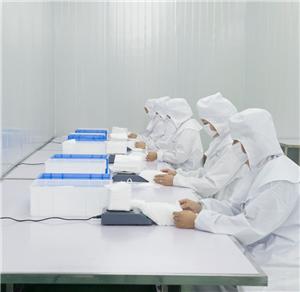
A technical guide to KN95 mask filtration efficiency testing methods, explaining the difference between salt and oil aerosol challenge tests and their implications for B2B respirator procurement.
KN95 Mask Filtration Efficiency Testing: Understanding Salt vs Oil Aerosol Challenge Methods
One of the most commonly misunderstood aspects of KN95 respirator filtration testing is the distinction between salt-based and oil-based aerosol challenge methods. B2B buyers who source respirators for different industrial applications must understand this distinction - it determines whether the respirator they are purchasing is actually certified for the particle types present in their target environment.
This article explains the GB2626 classification system (KN vs KP), the physics behind salt and oil aerosol challenge testing, and provides practical guidance for matching respirator classification to real-world particle exposure scenarios in B2B procurement.
GB2626 Classification: KN vs KP Explained
The GB2626 standard classifies particulate respirators into two families based on the type of challenge aerosol used in testing:
- KN series (Non-oily particles): Tested exclusively with sodium chloride (NaCl) aerosol. KN95, KN90, and KN100 respirators are designed to filter solid particulates and aqueous mists - dust, pollen, bacteria, viruses, welding fumes, and similar non-oily aerosols.
- KP series (Oily particles): Tested with paraffin oil aerosol in addition to or instead of NaCl. KP95, KP90, and KP100 respirators are designed for environments where oily particulates are present - machining mist, lubricant aerosols, pesticide sprays, and certain chemical fumes.
The numerical suffix (90, 95, 100) indicates the minimum filtration efficiency: KN95 requires ≥95% efficiency against the specified challenge aerosol. The critical point is that a KN95 respirator has never been tested against oily particles - it may or may not filter them effectively, but the certification does not guarantee it.
The Physics of Salt Aerosol Challenge Testing
In NaCl challenge testing, the aerosol is generated by atomizing a sodium chloride solution and drying the droplets to produce solid salt crystals. These crystals have a count median diameter (CMD) of 0.075µm. The test measures how many of these sub-micron solid particles penetrate the filter material.
The filtration mechanism for solid particles involves three primary mechanisms:
- Interception: Particles following a gas streamline come close enough to a filter fiber to be captured. Most effective for particles in the 0.1-1µm range.
- Inertial impaction: Larger particles have enough momentum to deviate from the streamline and collide with fibers. Dominant for particles >1µm.�m.
- Diffusion (Brownian motion): Very small particles (<0.1µm) move randomly due to molecular collisions, increasing their probability of contacting a fiber.er.
Additionally, the electrostatic charge on meltblown polypropylene enhances capture through electrostatic attraction. This is why meltblown quality control directly impacts filtration performance - the electrostatic charge treatment process determines how effectively the filter captures particles in the most-penetrating particle size (MPPS) range of 0.1-0.3µm.
The Physics of Oil Aerosol Challenge Testing
In oil challenge testing, the aerosol is generated by atomizing paraffin oil to produce liquid droplets with a CMD of 0.185µm. These liquid droplets behave fundamentally differently from solid salt crystals:
- Liquid spreading: When an oil droplet contacts a filter fiber, it spreads along the fiber surface rather than remaining as a discrete particle. This can clog the filter structure over time, increasing breathing resistance.
- Electrostatic charge degradation: Oil droplets can dissolve or neutralize the electrostatic charge on meltblown fibers. A filter that achieves 96% efficiency against NaCl may drop to 85% or lower against oil aerosol because the electrostatic enhancement is compromised.
- Loading behavior: Oil aerosol loading is cumulative and irreversible - the filter becomes progressively more loaded and resistant, unlike solid particle loading where some particles may dislodge during exhalation.
This is why KP-series respirators typically use different filter media or additional treatment to resist oil degradation. A KN95 respirator used in an oily environment may initially filter adequately but rapidly lose efficiency as the electrostatic charge is neutralized by oil deposition.
Matching Respirator Classification to Application: A B2B Procurement Guide
For procurement teams specifying respirators for different end-user applications, the following table provides guidance on appropriate classification:
| Application Environment | Particle Type | Recommended Class |
|---|---|---|
| Healthcare / infection control | Non-oily (bacteria, viruses, droplets) | KN95 or equivalent |
| Construction / demolition dust | Non-oily (silica, concrete dust) | KN95 or equivalent |
| Welding / metalworking | Non-oily (metal fumes, ozone) | KN95 (with valve recommended) |
| Machining with cutting fluids | Oily (metalworking fluid mist) | KP95 or higher |
| Pesticide / chemical spraying | Oily (pesticide aerosols) | KP95 or higher |
| Pharmaceutical manufacturing | Non-oily (powder, tablet dust) | KN95 or equivalent |
| Oil refining / petrochemical | Oily (hydrocarbon mists) | KP95 or higher |
Buyers sourcing for healthcare applications - where the primary concern is biological aerosols - can confidently specify KN95. However, buyers sourcing for industrial applications involving oil mists must specify KP-series respirators or risk providing inadequate protection. The GB2626 standard technical guide provides additional detail on classification requirements.
International Equivalents: How KN/KP Maps to NIOSH and EN Standards
Understanding how GB2626 classifications map to international standards helps B2B buyers cross-reference specifications:
- NIOSH N-series (N95, N99, N100): Non-oil resistant. Equivalent to GB2626 KN series. Not suitable for oily environments.
- NIOSH R-series (R95, R99, R100): Oil-resistant for up to 8 hours. No direct GB2626 equivalent but closer to KP series.
- NIOSH P-series (P95, P99, P100): Oil-proof. Equivalent to GB2626 KP series.
- EN 149: FFP1, FFP2, FFP3 are tested against both NaCl and paraffin oil, making them broadly equivalent to KP-series classification.
This mapping explains why KN95 vs FFP2 equivalence is not straightforward: FFP2 is tested against both salt and oil aerosols, while KN95 is tested only against salt. In non-oily environments, both provide equivalent protection. In oily environments, FFP2 provides protection that KN95 does not guarantee.
Implications for B2B Procurement Specifications
When writing procurement specifications for KN95 respirators, include the following clauses to ensure the testing methodology matches your application:
- Specify the particle type: State explicitly whether the respirator must filter non-oily particles only (KN95 sufficient) or must also handle oily particles (KP95 required).
- Require test reports showing the challenge aerosol: The report must specify whether NaCl or paraffin oil was used. A report that does not state the challenge aerosol is incomplete.
- For multi-environment use: If end-users may encounter both oily and non-oily particles, specify FFP2 or KP95 rather than KN95, or provide separate respirators for different work zones.
- Include electrostatic charge stability testing: For KN95, request data showing filtration efficiency after simulated aging, since electrostatic charge decay is the primary failure mode for non-oily particle filters. The shelf life testing methods article covers this in detail.
Key Takeaways
- KN95 = non-oily particles only: Tested with NaCl aerosol. Suitable for healthcare, construction, and most industrial dust applications.
- KP95 = oily and non-oily particles: Tested with paraffin oil aerosol. Required for machining, chemical processing, and petrochemical environments.
- Oil degrades electrostatic filters: KN95 used in oily environments will lose efficiency over time as oil neutralizes the electrostatic charge.
- International equivalents differ: FFP2 is tested against both aerosol types; N95 is non-oil only like KN95; P95 is oil-proof like KP95.
- Procurement specs must state the application: Without knowing the particle environment, the correct respirator classification cannot be determined.
By understanding the distinction between salt and oil aerosol challenge testing, B2B procurement teams can specify the correct respirator classification for each application, ensure test documentation matches the intended use case, and avoid the costly and dangerous mistake of deploying KN95 respirators in environments where only KP95 or equivalent oil-resistant protection will provide adequate filtration.