
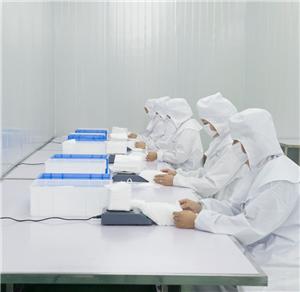
Ein umfassender Leitfaden zur Interpretation von TSI-8130-Testberichten für KN95-Atemschutzmasken, der B2B-Käufern hilft, Penetrationsdaten, Widerstandswerte und Chargenkonsistenz für die Überprüfung von Großeinkäufen zu verstehen.
KN95 Mask Filtration Lab Testing: How to Interpret TSI 8130 Test Results for Bulk Orders
For B2B buyers responsible for procuring KN95 respirators in container-load quantities, the ability to read and interpret a TSI 8130 test report is a critical procurement skill. The TSI 8130 Automated Filter Tester is the industry-standard instrument used to measure particulate filtration efficiency of respirator filter media. Understanding its output - not just the final percentage - allows buyers to identify subtle quality issues that a simple "≥95%" pass/fail certificate would never reveal.
This guide walks through the key sections of a TSI 8130 test report, explains what each parameter means for real-world respirator performance, and provides a checklist for evaluating whether a supplier's test data supports their filtration claims.
What the TSI 8130 Actually Measures
The TSI 8130 generates a neutralized challenge aerosol and passes it through the filter material at a controlled flow rate. Two photometers - one upstream, one downstream of the filter - measure particle concentration. The ratio of downstream to upstream concentration gives the penetration percentage. Filtration efficiency is calculated as 100% minus penetration.
For KN95 certification under GB2626, the standard test parameters are:
- Challenge aerosol: Sodium chloride (NaCl) for non-oily particle classification (KN class)
- Particle size: Count median diameter (CMD) of 0.075µm ± 0.020µm with geometric standard deviation ≤1.86
- Flow rate: 85 L/min (representative of adult breathing at high work rate)
- Aerosol concentration: ≤200 mg/m³
- Test area: 100 cm² (standard filter sample area)
- Conditioning: Samples pre-conditioned at 25±5°C, 30±10% RH for ≥24 hours
The pass threshold for KN95 is ≤5% penetration (≥95% efficiency). For comparison, KN90 allows ≤10% penetration, and KN100 requires ≤0.01% penetration.
Reading Between the Lines: What a TSI 8130 Report Reveals
A complete TSI 8130 test report contains more than just the final efficiency number. Here is what procurement teams should examine:
Initial vs. Loaded Efficiency
Some test protocols measure efficiency at the beginning of the test (initial penetration) and again after a specified loading period. If the report shows only initial penetration, the filter may degrade as it loads with particles during use. A supplier that provides loaded efficiency data demonstrates confidence in their filter media's sustained performance - an important indicator for meltblown quality control.
Resistance Values
Alongside penetration, the TSI 8130 measures breathing resistance (pressure drop) across the filter material. Under GB2626-2006, inhalation resistance must not exceed 350 Pa at 85 L/min, and exhalation resistance must not exceed 250 Pa. A filter with very high efficiency but also very high resistance will be uncomfortable and may cause users to break the seal - defeating the protection entirely.
Sample-to-Sample Variability
A rigorous test report includes multiple samples (typically 3-5) from the same production batch. If the penetration values across samples vary significantly (e.g., 2.1%, 4.8%, 1.3%), this indicates inconsistent filter media quality - a production process control problem. Consistent values (e.g., 2.1%, 2.3%, 2.0%) indicate stable manufacturing. This consistency metric is often more telling than the absolute efficiency number.
Why NaCl Challenge vs. Oil Challenge Matters for KN95
GB2626 defines two classes of particulate filters: KN (non-oily) and KP (oily). KN95 respirators are tested with NaCl aerosol only. This means they are certified for protection against non-oily particles - dust, mist, microorganisms, and similar particulates. They are not certified for oily particle environments (oil mists, lubricants, certain industrial aerosols).
If your procurement specification requires protection against oily particles, KN95 is the wrong classification - you need KP95 or higher. Always confirm that the test report uses the correct challenge aerosol for your application. For a deeper understanding of how these standards compare across regions, procurement teams can consult the GB2626 standard complete technical guide.
Verification Protocol: 7-Point TSI 8130 Report Checklist
Before accepting a supplier's filtration test documentation for a bulk order, use this checklist:
- Instrument identification: The report should name the TSI 8130 (or equivalent CNAS-approved instrument) and include its calibration date and serial number.
- Challenge aerosol specification: Confirm NaCl for KN95, with CMD of 0.075µm ± 0.020µm.
- Flow rate confirmation: Must be 85 L/min ± 2 L/min. Any deviation invalidates the comparison to GB2626 thresholds.
- Number of samples tested: Minimum 3 samples per model. A single-sample report has limited statistical value.
- Individual penetration values: Each sample's penetration must be ≤5%. Some reports show only the average - request individual values.
- Resistance data: Inhalation ≤350 Pa, exhalation ≤250 Pa. High resistance with high efficiency suggests excessive material density that compromises wearability.
- Lab accreditation cross-check: Verify the CNAS accreditation number on the CNAS website or through ILAC-MRA.
Connecting TSI 8130 Data to Real-World Procurement Decisions
A TSI 8130 test report tells you what the filter media can do under laboratory conditions. But B2B buyers need to translate that into confidence about what shipped product will do in the field. Here is how experienced procurement professionals use the data:
Batch Consistency Verification
For orders exceeding 500,000 units, request batch-level sampling and TSI 8130 re-testing at an independent laboratory. The batch test results should fall within ±1% of the original type test. Significant deviation indicates production drift - a common issue when suppliers change meltblown suppliers or adjust line speed without re-validating.
Shelf Life Projection
The electrostatic charge on meltblown fabric decays over time. A filter that passes at 2% penetration when freshly manufactured may degrade to 4-5% after 2 years of storage in suboptimal conditions. Request accelerated aging test data that shows filtration performance at the end of the claimed shelf life. This connects directly to shelf life testing and laboratory validation methods that procurement teams should review.
Comparison Across Suppliers
When evaluating multiple suppliers, standardize the comparison by requesting TSI 8130 test reports from all candidates under identical parameters. A supplier whose report shows 1.5% penetration with 120 Pa resistance offers a better balance than one showing 3% penetration with 340 Pa resistance - even though both technically pass KN95.
Red Flags Specific to TSI 8130 Reports
Be alert for these specific issues when reviewing TSI 8130 test documentation:
- Report shows efficiency >99.5% for a standard KN95: This is suspiciously high for a product rated at ≥95%. It may indicate the test was conducted at a lower flow rate, with larger particles, or the report is not genuine. Genuine KN95 filters typically test between 96-98% efficiency.
- Resistance values missing entirely: A report that provides only penetration data without resistance is incomplete. Both parameters are required under GB2626.
- Test date more than 12 months before the quotation date: Meltblown electrostatic charge treatment processes change. An old test may not represent current production.
- Report references ASTM F2299 or EN 14683 methods: These are surgical mask standards, not respirator standards. The test methodology is different and the results are not directly comparable to GB2626.
Key Takeaways
- The TSI 8130 report contains far more useful data than the final efficiency percentage - learn to read the full report.
- Sample-to-sample consistency is as important as the absolute penetration value.
- Breathing resistance data must accompany filtration efficiency data for meaningful procurement evaluation.
- Always verify the test parameters (aerosol, flow rate, particle size) match GB2626 requirements.
- For large orders, invest in independent batch-level re-testing to verify ongoing production quality.
Procurement teams who master TSI 8130 report interpretation gain a significant advantage in supplier evaluation. They can distinguish between manufacturers who simply purchase certificates and those who maintain genuine, verifiable quality control over their filtration performance - a distinction that matters enormously when the respirators are destined for healthcare workers, industrial safety programs, or government stockpiles where failure is not an option.