
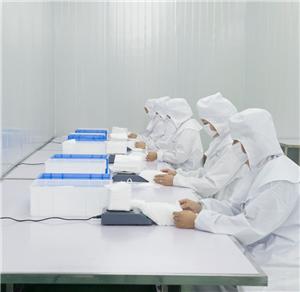
Un guide détaillé sur les méthodes d'essai d'efficacité de filtration des masques KN95, aidant les acheteurs B2B à comprendre les essais de pénétration des particules, à vérifier les rapports d'essais et à évaluer la documentation des fournisseurs pour l'achat en gros.
KN95 Filtration Efficiency Testing: What B2B Buyers Need to Know About Particle Penetration Methods
When procuring KN95 respirators at scale, understanding the filtration efficiency testing methods behind the certification is not optional - it is the difference between receiving compliant product and discovering batch failures during customs inspection or, worse, after distribution. B2B buyers who source KN95 respirators for hospital networks, government stockpiles, or industrial distribution must be able to interpret the testing methodology, not just the headline efficiency number on a certificate.
This article breaks down the particle penetration testing methods used to verify KN95 filtration performance, explains what each test actually measures, and provides a procurement framework for evaluating supplier test data before placing bulk orders.
GB2626-2019 vs GB2626-2006: Which Standard Applies to Your Shipment?
The GB2626 standard is the Chinese national standard for respiratory protective equipment. The 2006 version has been the reference for KN95 certification for over a decade, but GB2626-2019 introduced updated testing protocols and classification criteria. For B2B procurement, the distinction matters:
- GB2626-2006: Requires ≥95% filtration efficiency against non-oily particles at 0.3µm. This is the standard most existing KN95 certificates reference.
- GB2626-2019: Introduces stricter requirements for total inward leakage, breathing resistance, and modifies the classification system. Products certified under the 2019 version carry a different marking format.
When reviewing a supplier's certification documents, confirm which version of the standard the test report references. A KN95 respirator GB2626 standard technical guide can help procurement teams cross-reference the specific clauses that apply to their import market requirements.
How Particle Penetration Testing Actually Works
The core test for KN95 filtration efficiency uses a TSI 8130 automated filter tester (or equivalent). Here is what happens during testing:
- Aerosol generation: The machine generates a challenge aerosol of sodium chloride (NaCl) or paraffin oil particles. For KN95 under GB2626, NaCl is the standard challenge agent for non-oily particle filtration.
- Particle size distribution: The test aerosol has a count median diameter (CMD) of 0.075µm with a geometric standard deviation of ≤1.86. This means the test targets particles significantly smaller than the commonly cited 0.3µm - the mass median aerodynamic diameter (MMAD) is approximately 0.3µm, but the distribution includes particles down to sub-0.1µm levels.
- Flow rate: The test is conducted at 85 liters per minute (L/min), simulating a high-work-rate breathing pattern. This is more demanding than the 30 L/min used in some surgical mask standards.
- Penetration measurement: The tester measures particle concentration upstream and downstream of the filter material. The percentage of particles that penetrate the filter is the penetration value. Filtration efficiency = 100% - penetration%.
For a KN95 rating, penetration must not exceed 5% - meaning filtration efficiency must be ≥95%. But understanding the test conditions is critical: a result of "≥95%" tested at 85 L/min with NaCl aerosol is fundamentally different from "≥95%" tested at 32 L/min with a different particle size distribution.
What B2B Buyers Should Check on Test Reports
When a supplier provides a filtration efficiency test report, procurement teams should verify the following elements before accepting the documentation:
| Report Element | What to Verify |
|---|---|
| Testing laboratory | Must be CNAS-accredited (China National Accreditation Service) or equivalent ILAC-MRA recognized lab |
| Standard reference | Explicitly states GB2626-2006 or GB2626-2019 |
| Challenge aerosol | NaCl for non-oily particles (KN95); oil aerosol if claiming KP95 |
| Flow rate | 85 L/min ± 2 L/min for GB2626 testing |
| Penetration result | ≤5% (equivalent to ≥95% efficiency) |
| Sample conditioning | Pre-conditioned at 25±5°C and 30±10% RH for 24 hours minimum |
| Report date and validity | Typically valid for the product model; confirm the report matches the current production model |
Buyers evaluating BFE vs PFE test reports should also cross-reference whether the supplier's KN95 filtration claim is based on GB2626 particle testing or on BFE/PFE testing - these are different test methods with different particle size targets and flow rates.
Common Red Flags in Filtration Test Documentation
Over years of reviewing supplier documentation, several patterns emerge that should trigger additional due diligence:
1. Missing Laboratory Accreditation Number
A test report without a CNAS accreditation number or ILAC-MRA logo is not independently verifiable. Any supplier can produce a document that looks official - the accreditation number allows procurement to cross-check with the issuing laboratory.
2. Efficiency Claims Without Flow Rate
Some suppliers market "≥99% filtration efficiency" without specifying the test conditions. A mask can achieve 99% filtration at very low flow rates (e.g., 15 L/min) but fail at the 85 L/min required by GB2626. Always confirm the flow rate matches the standard.
3. BFE Test Used to Imply GB2626 Compliance
BFE testing (used for surgical masks under ASTM or EN 14683) uses a 3.0µm particle challenge at 28 L/min. This is a fundamentally different test from GB2626's 0.075µm CMD at 85 L/min. A high BFE score does not automatically translate to KN95-level particulate filtration. For a detailed comparison, procurement teams can reference guidance on filtration efficiency standards explained for buyers.
4. Test Report Date Significantly Predates Current Production
If the test report is more than 2-3 years old and the supplier claims ongoing production of the same model, request a current batch test or at minimum a reconfirmation letter from the testing lab. Material suppliers and production processes change over time.
Practical Procurement Framework: Verifying Filtration Claims
For buyers preparing to place a bulk KN95 order, the following step-by-step approach minimizes the risk of receiving non-compliant product:
- Request the full test report, not just the certificate. The certificate is a summary; the test report contains the methodology, equipment, and raw data.
- Verify the testing laboratory through CNAS or ILAC-MRA databases. A legitimate lab will appear in these registries.
- Confirm the product model on the report matches the model being quoted. Suppliers sometimes present test reports for a different (often higher-spec) model than the one they intend to ship.
- Request pre-shipment batch sampling for independent third-party re-testing. This is standard practice for government tenders and large hospital network orders.
- Understand the relationship between filtration efficiency and breathing resistance. A filter that achieves 99% efficiency but has excessive breathing resistance may be uncomfortable for extended wear. The breathability and comfort evaluation should accompany filtration data in procurement decisions.
The Role of Meltblown Quality in Sustained Filtration Performance
Filtration efficiency testing captures performance at a single point in time. But KN95 respirators must maintain filtration performance throughout their rated wear duration - typically 8 hours for a cup-style respirator. The key variable is the electrostatic charge on the meltblown polypropylene layer.
Meltblown fabric achieves its filtration performance through a combination of mechanical filtration (interception, inertial impaction, diffusion) and electrostatic attraction. The electrostatic charge is applied during manufacturing and gradually decays over time - particularly under high humidity or temperature conditions. This is why shelf life testing and storage condition compliance directly affect whether a respirator will still meet its filtration claim at the end of its rated storage period.
Buyers should ask suppliers about their meltblown sourcing and electrostatic charge treatment process. A manufacturer with in-house meltblown production - like Justsun's manufacturing facility with its 26,100m² production base - has better control over this critical input compared to suppliers who purchase meltblown on the open market.
Key Takeaways for B2B KN95 Procurement
- Understand the test behind the number: ≥95% is meaningful only when you know the particle size, flow rate, and challenge aerosol used.
- Verify lab accreditation: CNAS or ILAC-MRA recognition is non-negotiable for credible test reports.
- Match model numbers: The tested model must match the shipped model - no exceptions.
- Request batch-level verification for large orders: A type test certificate is not a guarantee of ongoing batch quality.
- Connect filtration to real-world performance: Filtration efficiency, breathing resistance, and shelf life are interrelated. Evaluate them together, not in isolation.
By applying this framework, procurement teams can move beyond surface-level certification checks and make sourcing decisions grounded in the actual testing methodology that underpins KN95 filtration claims. This is how experienced buyers reduce the risk of non-compliant shipments and build reliable, long-term supply relationships with manufacturers who can consistently deliver certified product at scale.